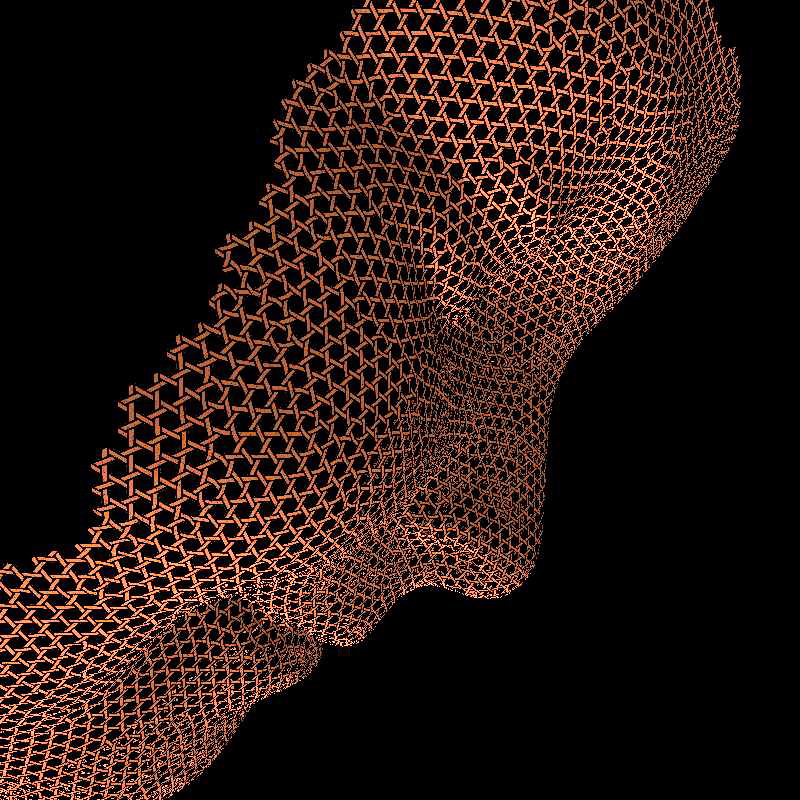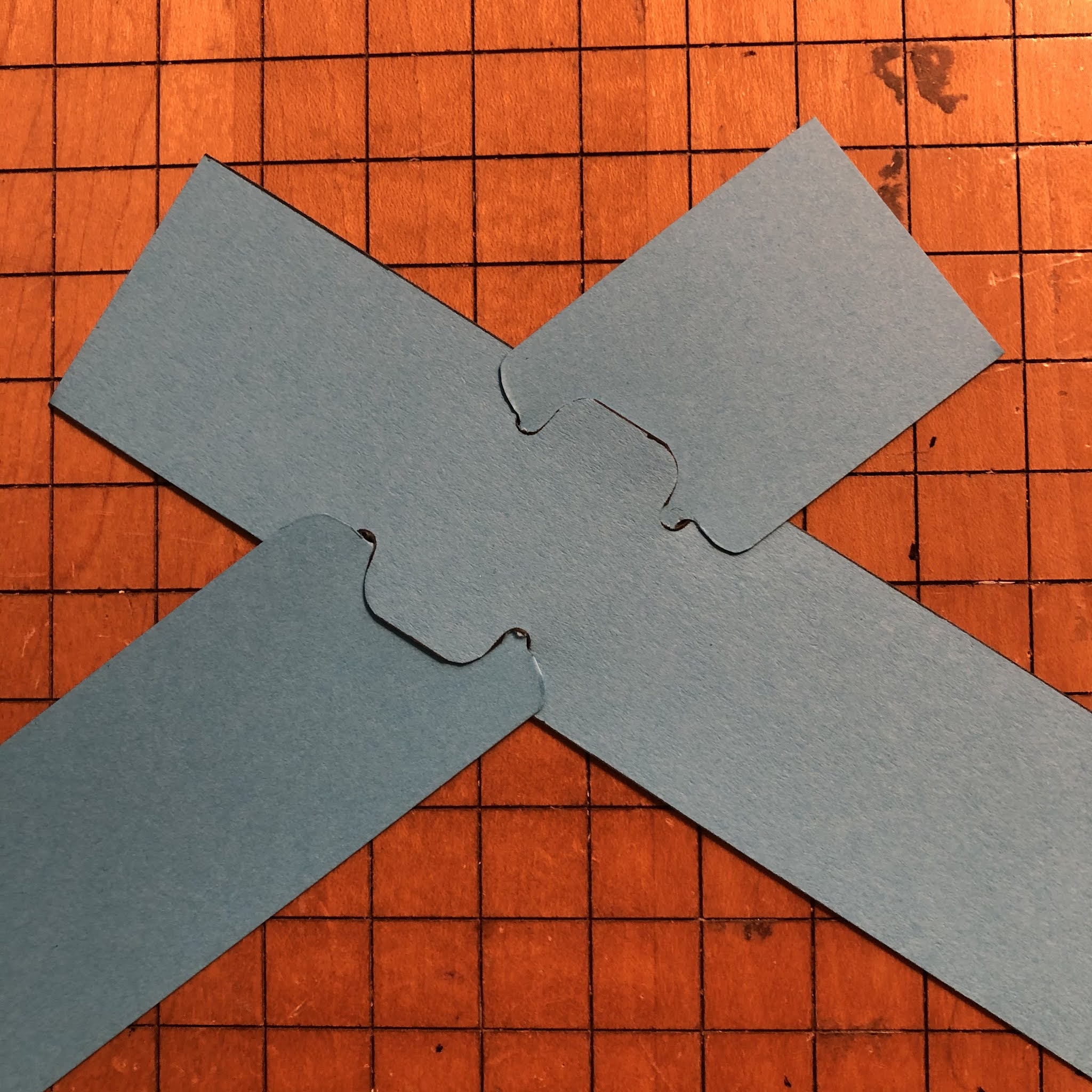


The fourth notch is engaged by bending the sides of both weavers upward, as in the photo below:


Thin, flat weavers can be locked together at a fixed position and angle of crossing with four side notches in each weaver. In an x-ray view of the completed locked crossing, the respective notches just barely overlap. For a 90-degree crossing the overlap areas form a square (the notches on each weaver may not appear to be arranged in a square because the locus of overlap is eccentrically located on each notch.)


Three copies of the cartesian grid cannot be overlaid into a pattern that is both periodic and isotropic. This is a familiar problem in designing halftone patterns for printing. The traditional arrangement of three square-grid halftones avoids distracting moire patterns with a 120° rotation dispersal that results in a pattern of dot 'rosettes' that is isotropic but not periodic. Wang and Loce show the way towards periodicity. If the orthogonal grids are not square but 1:0.866 rectangles (i.e, based on the base-to-altitude ratio of equilateral triangles), and still arranged 120° to each other, isotropic and periodic patterns are possible.
 |
| Three copies of a rectangular grid with aspect ratio 0.866 can be rotated 120° to each other and still form periodic patterns. |
 |
| Three copies of a slightly sheared cartesian grid can be rotated 120° to each other and form periodic patterns. |
A cartesian grid has two line directions, after three copies are dispersed 120° from each other, there are six line directions (see figure below.) It is somehow easier to perceive these six directions as three narrow-angle 'flashlight beams' with (half-angle) beam-spread of 15°.
 |
| Three right-angles rotated 120° to each other tend to be perceived as three narrow beams with half-angle 15°. |
In Panda, Maulik, Chakraborty, and Khastgir there a several periodic solutions for billiards played on an equilateral triangular table. Any of these solutions that preserve the full symmetry of the triangle could decorate the equilateral triangles of a deltahedron resulting in a surface wrapped by geodesic lines.
 |
| Periodic solutions to billiards on an equilateral triangle table (from Panda, Maulik, Chakraborty, and Khastgir.) |
The solution labelled (m=2, n=5) caught my eye, me thinking that the lines were orthogonal (in fact, they are just slightly oblique.)
Flat weaving in this pattern would look something like this:
 |
| Flat weaving the (m=2, n=5) periodic solution to billiards-on-a-triangle. Heavy lines emphasize the kagome-like organization. |
Extended in this way, it becomes easier to see that the lines are not quite orthogonal. This geometric construction shows that an angle that needs to be 15° for orthogonality is actually atan(sqrt(3)/7) = 13.8979°.
 |
| For lines in the periodic pattern to cross at 90°, the apex angle of the green triangle would need to be 15°. This geometric construction shows that it is instead arctangent of the ratio of one equilateral altitude to 3.5 equilateral sides. |