
Many interesting deltahedra, foremost among them the triangle-faced Platonic solids, are not knotted, so it is worthwhile looking at joining up link components to yield knots. Following Q. Xing, E. Akleman, J. Chen, and J. L. Gross in “Single-cycle plain-woven objects,” 2010 Shape Modeling International Conference, IEEE, pp. 90-99, 2010, we find that a link with n components can be converted to a knot by making n-1 small edits. For example, the tetrahedron, octahedron, and icosahedron with 3, 4, and 6 components, become knotted after 2, 3, and 5 edits respectively.
If an edge of a Tait graph carries two different link components (e.g., every edge in the tetrahedral graph illustrated above), then simply subdividing that edge with a 2-valent vertex will join the two link components into one.

In the tetrahedron, performing this edit on any two edges that share a vertex joins the three link components into one. Road code: 3.6 8.1 9.12 2.13 14.7 15.0 17.10 11.18 19.16 21.4 5.22 23.20, where the four edges in boldface get folded to a 180° dihedral angle.
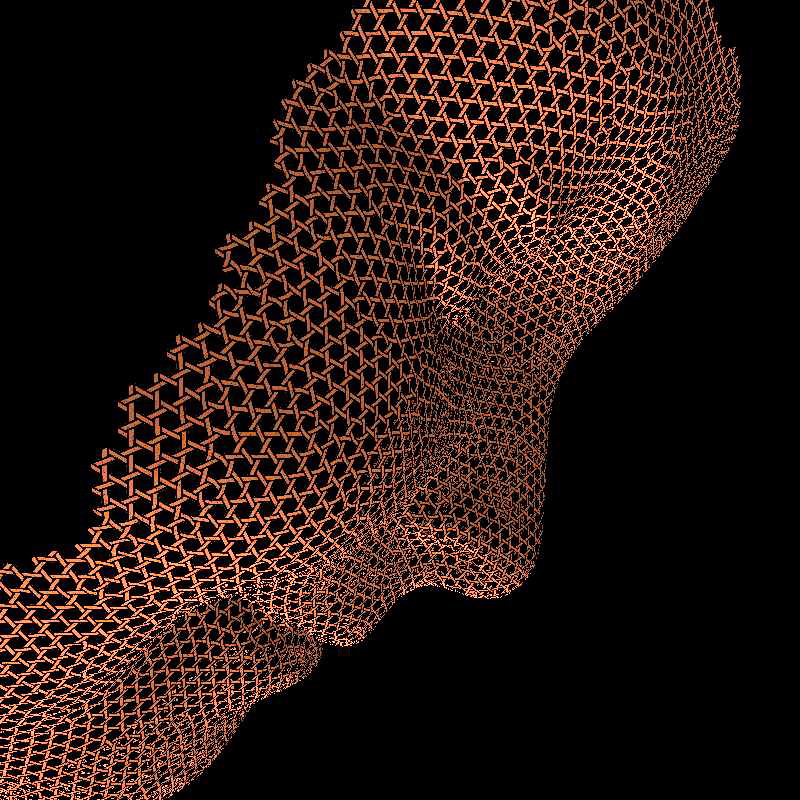
 The 2-eared tetrahedron, a knotted degenerate deltahedron.
The minimal set of edges that must be edited always constitutes a spanning tree in the dual of the Petrial, or DP. The Petrial of the tetrahedron is the hemicube, and the dual of the hemicube is the hemi-octahedron. Since the spanning trees of a graph are independent of its embedding, it suffices to draw the DP in the plane in any convenient way, for the hemi-octahedron that is most simply a triangle with doubled edges.



No comments:
Post a Comment