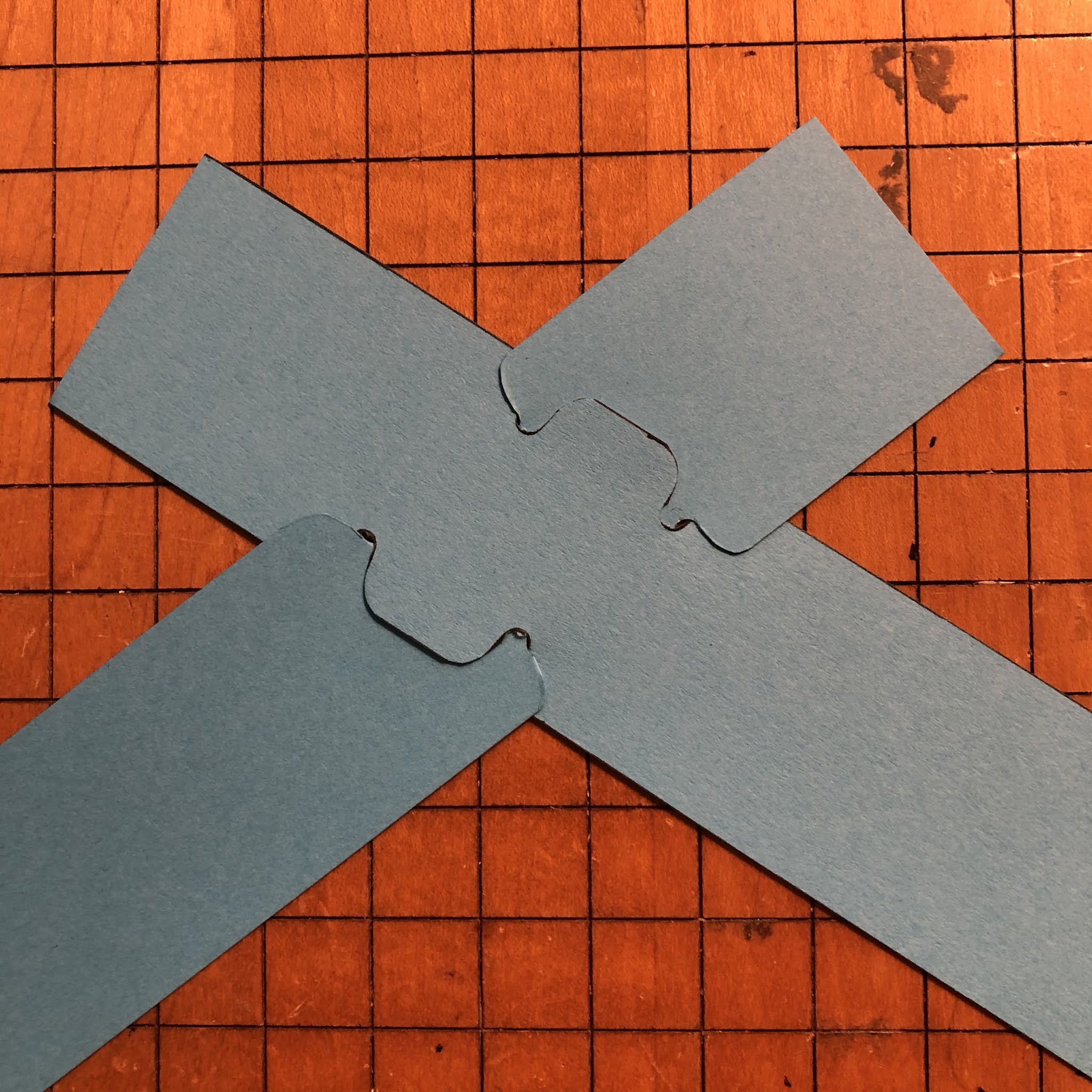
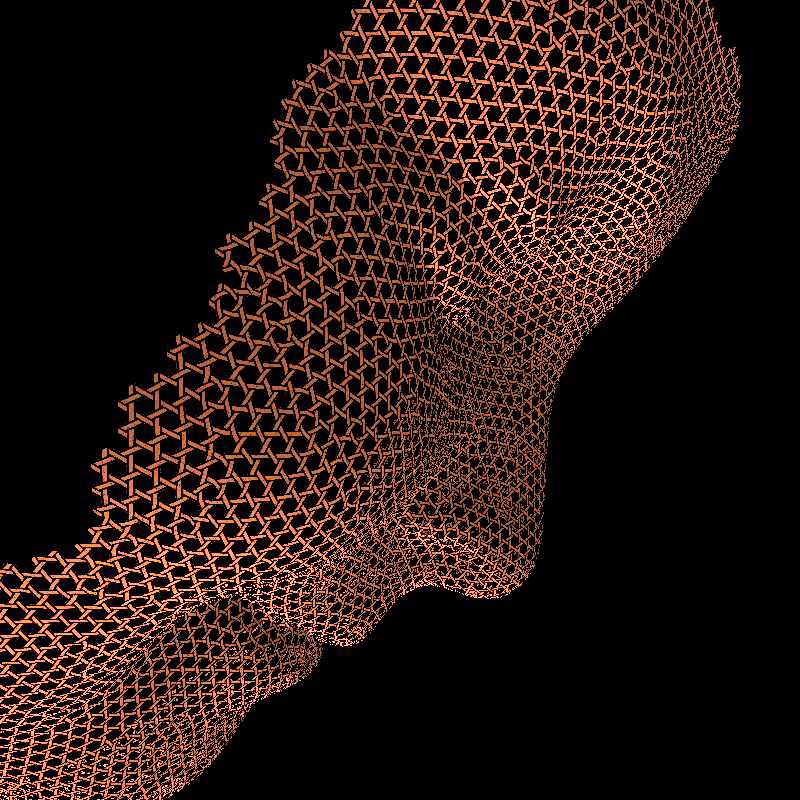
If all weave crossings will be locked at the same angle, the same notch pattern can be repeated with high frequency along the length of the weavers. The wavelength can be an integer divisor of the width of one crossing, for example, in the photo and the diagram below, the repetition wavelength is 1/2 the width of one locked, 90° crossing.
This allows a variety of shapes to be made with the same set of notched weaving strips since the distance between successive crossings can be adjusted to any integer number of wavelengths. On the other hand, if the strips are custom notched, any angle and spacing of crossing can be accomodated, but the strips may only be useful for the intended construction.Wednesday, March 31, 2021
Thursday, March 25, 2021
Correction for engagement windows
The geometry of an oblique locked crossing is not fundamentally altered if the engagement windows are too large to be neglected. The radius, r, used in the calculation, remains the same, but the mechanical radius of the hole cut into the weaver, rm, must be made larger. If the 'thickness' of the engagement window (seen as the cross-section of a double convex lens) is t, then rm = r + t/2.
The best value for t needs to be determined by experiment, as it will depend not only on the thickness of the weaver, but also its elasticity, the desired stiffness of the joint, and how acceptable permanent plastic deformation of the weaver might be.
Geometry of oblique locked crossings
When two weavers of equal width cross at an angle, say 2θ, their area of overlap is a rhombus. If the weavers are thin enough that the engagement windows of their oblique locked crossing can be approximated as points, those four points also form a rhombus (dotted lines in diagram above) that shares the same diagonal lines as the former, but with angles slightly different—assuming the radius, r, at the bottom of the notches is not zero.
In the diagram, weavers are only indicated out to the width, 2h, where the centers of the notch radii are located. The point where the centerlines of the two weavers cross makes a natural origin for the diagram; in particular, we choose the perpendicular to the centerline at that point on our chosen weaver (the gray one) to define the line of x = 0 for our coordinates. Taking h, r, and θ as given, the geometric problem is to find the x-coordinates of the centers of the four holes (the geometry of the other weaver will be simply the mirror image of this one.)
The solution requires repeated use of trigonometric identities for geometrically similar right triangles, all having acute angles of θ and 90°-θ. Such an analysis yields these expressions for the marked dimensions indicated in the diagram:
xL = r/cosθ
xR = r/sinθ
sL = htanθ
sR = h/tanθ
The x-coordinates of the circle centers on the inner edge (upper edge in the diagram) can then be calculated from:
xL = cL - sL
xR = sR - cR
For the circle centers on the outer edge, just multiply by -1.
Tuesday, March 23, 2021
Oblique locked crossings
Thursday, March 18, 2021
Sinusoidal notches for locked crossings
The fourth notch is engaged by bending the sides of both weavers upward, as in the photo below: