Wednesday, November 5, 2014

Weaving bricks

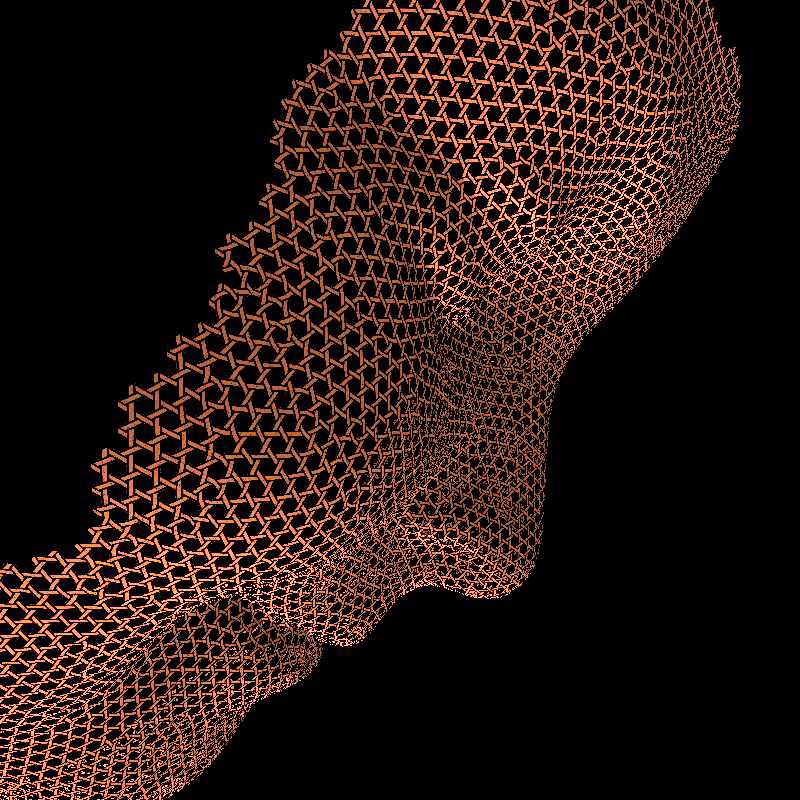
A puck weaver of length 2 and corrugation frequency 3.
There is a "teleological" problem in polyphase unit weaving when the composite, polyphase weavers are shingled. Shingling effectively assigns to each composite weaver an orientation, i.e., the direction that the units "lean."As new crossing weavers are encountered in building up the basket surface, the entire basket would need to have been designed in advance in order to know which orientation to start them in.

Brick-laid unit weavers do not have an orientation, and thus escape this difficulty. Since all weavers form closed loops of even length, identical puck "bricks" that form these loops by being laid end-to-end  must have even length. In fact for the greatest versatility of shape they must have length two.

That leaves very little overlap for bricks in adjacent courses to engage one another, so higher frequency corrugation is useful for greater stiffness and frictional engagement between courses. The little puck "brick" pictured above begins to gain some inevitability.

In a single-layer course of these bricks laid end-to-end, spliced squares alternate with un-spliced squares. The un-spliced squares are the ones that the over-and-under pattern of kagome weaving will expose on that face. On the other face, the spliced squares of this course will be covered by the un-spliced squares of the other course.

Thursday, October 9, 2014

Tensegrities from children's drawings

Many tensegrities can be generated from the operation of the map operation snub on planar graphs.

A connected drawing (for example, one drawn by not lifting the pencil off the paper between the start and finish, retracing over the same line being allowed) when adorned with dots every place lines cross, branch, or terminate, describes a planar map. Map operations exist that can translate any orientable map into a design for a tensegrity. Via such a map operation, any connected drawing drawn on a sheet of paper describes a tensegrity structure in the broad sense: a self-prestressed system that is not necessarily rigid. In particular, the tensegrity the drawing describes may be an articulated space mechanism rather than a rigid 3D structure.

The simplest procedure to describe uses map operation snub: replace every edge with a rectangle (more properly speaking, a topological quadrilateral) and exploit the orientability of the plane to consistently place struts along the all the 'Z' or all the 'S' diagonals of the rectangles.

When the map operation is applied, some of the edges in the resultant may have the same vertex at both ends (a degenerate edge,) or some edges may connect the same two vertices as another edge (a parallel, or redundant edge,) in other cases an edge may entirely coincide with a strut (a bow edge), in this way the the tensegrity may be simpler than the intermediate resultant map that describes it. For example, applying the map operation snub to a triangle produces a the famous three-strut tensegrity though the intermediate map is rather more complicated.

Wednesday, July 30, 2014

Winchworms: a Lanchester tourbillon driving a Spanish windlass

The build-your-own project I am working on for the Silver Spring Mini Maker Faire is a minimal wind-powered robot that inches its way upwind (when it gets a little help staying upright.) A winchworm consists of a wind oscillator based on the Lanchester tourbillon (see Den Hartog's Mechanical Vibrations) that drives a Spanish windlass mechanism to alternately contract and expand a bamboo bow. The feet of the bow are angled to turn alternate contraction and expansion into incremental forward movement.

More on my new blog Winchworms: Slow and Steady Wins the Race.

Winchworm under development: a test of an oscillating Lanchester tourbillon (made of paper) driving a Spanish windlass made of 1-lb test Dyneema fishing line that contracts and expands a bamboo bow.

Saturday, July 26, 2014

Twist instability actuators

Twisting up a thread shortens it, but this is not normally an efficient mechanism for use in mechanical engineering because most of the work of twisting goes into elastic stretching of the thread. However, when the ratio of twisting torque to thread tension (a ratio having dimensions of length) is large enough in proportion to the diameter of the thread, twist instabilities (solenoids and plectonemes) appear which cause further twisting to act against the external load that maintains the thread tension. This has been quantitatively demonstrated for the plectoneme instability of DNA. In effect, a thread containing twist instabilities becomes a very light and finely-threaded screw.

Behavior of the mechanism is quite non-linear at the onset of instability. For example, in the absence of non-linearity there is no advantage to pre-twisting a spanish windlass: turning the peg increases twist on one half of the other, but decreases twist on the other half to no net effect. However, if the spanish windlass is pre-twisted to near solenoidal transition, solenoid turns will add to one half, but not be subtracted from the other. A net contraction results with little wasted twisting.

Friday, July 25, 2014

Bamboo bow for a wind muscle

This is a 27" bamboo bow made by splitting a 1/2" diameter cane to 3/16" width. With a wind rotor made from 8 fluid ounce foam cups, it easily twists a single strand of 1-lb test Dyneema fishing line to solenoidal, even in a zephyr-like 1.5 m/sec. breeze. Stroke is about 3".

Not much of the fiber length is becoming solenoidal. No extra twist was built in.

Sunday, July 20, 2014

Windbot Muscles

Me with a newly-built windbot muscle.

A simple, muscle-like actuator for wind animated sculptures can be made by supporting a Savonius wind rotor on a taut thread. The thread needs to be very fine and strong. I have used Berkley Fireline of 1-lb test strength. A small Savonius rotor can be made by splitting two disposable cups and reassembling them with hot melt adhesive.

The wind rotor twists up the thread causing it to contract. When the wind dies down, the contraction slowly relaxes as the rotor spins in reverse.

The relaxation can be made very fast and controllable by using high-performance ball bearing swivels. Lazer Eagle Claw 75-lb test swivels work well enough with the windbot muscle shown here.

A Savonius wind rotor made from two disposable cups.


Detail of the wrap-around wire fitting that confines twist to the outboard sections of the doubled length of FireLine.


Suitable ball-bearing swivels for the muscle shown.

Saturday, July 12, 2014

Wind-powered plectoneme actuators

A plectoneme. Image quoted from B.C. Daniels et al., "Discontinuities at the DNA Supercoiling Transition."

I am working on a proposal for an artwork at World Maker Fair New York that uses wind-powered plectoneme actuators. A plectoneme is the twist instability that forms a hairpin side branch on a highly twisted fiber. As has been discovered in DNA biomechanics, when a twisted fiber forms a plectoneme it becomes the mechanical equivalent of a threaded screw: additional twisting at constant tension shortens the length of the fiber. The shortening continues to nearly full contraction of the fiber as demonstrated in my video on "writhing thread" actuators. That demo used a high-current pulse to drive a cellphone vibrator motor to lift a weight weighing about 30 times the motor's weight to almost 100% contraction of the fiber.

After plectonemes form, further twisting of a fiber under constant tension is converted into linear motion. Image quoted from S. Forth et al., "Abrupt Buckling Transition Observed during the Plectoneme Formation of Individual DNA Molecules."