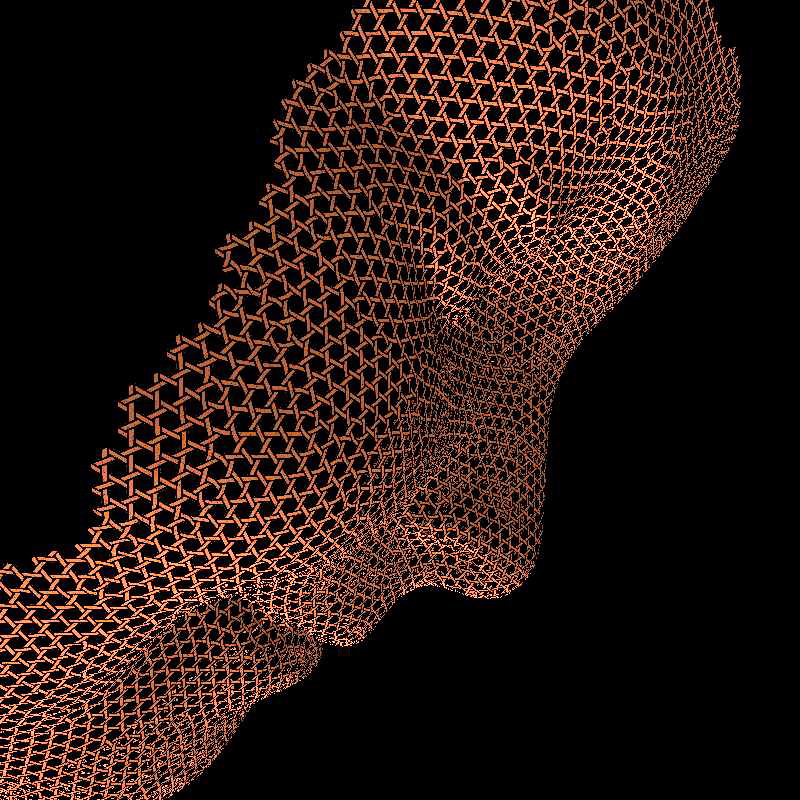
Among the smallest knotted (unicursal or single-cycle) kagome baskets are some elongated small-diameter shapes reminiscent of carbon nanotubes. Shown above is the medial graph of Plantri 15-253174, which has the following road code: 10.17 4.21 24.1 27.6 31.12 14.33 8.37 2.41 42.23 43.0 25.44 46.39 48.19 29.50 52.35 54.15 32.55 13.56 57.34 53.58 59.16 11.60 30.61 51.62 63.36 9.64 65.18 49.66 28.67 7.68 69.38 47.70 71.20 5.72 26.73 45.74 75.40 3.76 77.22
This shape can be lengthened 6 vertices at a time. Its shorter predecessor is Plantri 9-12 of the previous post. The endcaps in both baskets are the same, the middle section, which in the 3-regular Tait graph is all hexagonal faces, gets longer 6 hexagons at a time. In carbon chemistry this would be a non-classical fullerene since each end cap has 1 triangular, 1 square, and 1 pentagon face. The face histogram for the 3-regular graph is [0 0 0 2 2 2 9].Friday, February 13, 2026
Wednesday, February 11, 2026
Unicursal deltahedra with some symmetry and vertex degrees less than 7
The graph dual of Plantri 9-12, and its realization as knotology weaving
A deltahedron is a polyhedron where all faces are equilateral triangles. A deltahedron is unicursal if its skeletal graph is a Tait graph of a knot. The "knot" in such case is a kagome basket, the weaving of which is easily encoded because of the simple structure of a knot as opposed to a multicomponent link.
A 3-connected triangulation of the sphere might describe a deltahedron if the geometry works for equilateral faces. The Plantri software which is built in to SageMath, can generate 3-connected triangulations. These can be filtered for unicursality by counting spanning trees (another feature built in to Sage Math): a plane graph is unicursal if it has an odd number of spanning trees. In the list of candidate unicursal deltahedra given here, the results have been further filtered to have no vertex of degree 7 or higher, and to have some symmetry, |Aut|>1, as these are perhaps the most interesting to weave.
The "road codes" given will be explained in a later post. The "Plantri identifiers" given here are the number of vertices in the triangulation followed by the listing ordinal when Plantri is asked to generate all 3-connected triangulations on the sphere with that number of vertices.
Unicursal polyhedral triangulations with |Aut|>1 and vertex degrees < 7
Plantri 5-0: |Aut|= 12 Vdeg = [2 3]
7.2 0.9 5.10 12.3 13.8 1.14 6.15 11.16 17.4
Plantri 7-1: |Aut|= 4 Vdeg = [2 3 0 2]
0.9 11.6 3.14 16.1 8.17 19.10 20.5 13.22 2.23 24.15 25.4 21.26 12.27 7.28 29.18
Plantri 7-2: |Aut|= 6 Vdeg = [3 0 3 1]
0.11 12.5 7.14 16.9 3.18 20.1 10.21 22.15 23.8 17.24 2.25 26.19 27.4 13.28 6.29
Plantri 7-3: |Aut|= 20 Vdeg = [0 5 2]
7.0 3.10 13.6 9.16 2.17 19.12 20.5 15.22 8.23 1.24 25.18 26.11 27.4 21.28 14.29
Plantri 8-8: |Aut|= 2 Vdeg = [1 3 3 1]
11.2 4.13 16.9 17.0 6.19 15.22 23.10 24.1 25.18 7.26 21.28 14.29 30.3 31.12 5.32 33.20 34.27 35.8
Plantri 9-12: |Aut|= 2 Vdeg = [2 2 2 3]
4.11 14.1 17.6 8.19 2.23 24.13 25.0 15.26 28.21 30.9 18.31 7.32 33.20 29.34 35.10 5.36 16.37 27.38 39.22 3.40 41.12
Plantri 9-27: |Aut|= 2 Vdeg = [1 4 1 3]
1.8 11.4 2.17 9.18 21.6 24.15 13.26 23.28 29.16 3.30 10.31 19.32 33.0 34.7 35.22 36.27 37.14 25.38 12.39 5.40 20.41
Plantri 9-31: |Aut|= 4 Vdeg = [2 3 0 4]
12.3 5.14 17.8 11.20 21.4 22.13 2.23 25.0 6.27 15.28 30.9 31.18 24.33 34.1 35.26 7.36 16.37 29.38 39.10 40.19 41.32
Plantri 9-32: |Aut|= 2 Vdeg = [2 1 4 2]
4.11 13.2 16.9 7.18 1.22 12.23 24.3 25.14 20.27 30.5 10.31 32.15 33.26 21.34 0.35 29.36 37.6 38.17 8.39 19.40 41.28
Plantri 9-40: |Aut|= 4 Vdeg = [0 5 2 2]
11.2 6.15 18.3 19.12 0.21 9.22 16.25 26.5 28.13 29.20 1.30 10.31 23.32 34.7 14.35 36.27 4.37 38.17 24.39 33.40 41.8
Plantri 9-47: |Aut|= 2 Vdeg = [1 2 5 1]
9.2 7.14 17.4 19.12 21.0 11.24 18.25 5.26 28.15 29.8 30.1 31.22 20.33 13.34 6.35 27.36 37.16 38.3 39.10 40.23 41.32
Plantri 10-140: |Aut|= 2 Vdeg = [1 4 1 4]
0.9 11.2 5.14 21.4 22.13 7.24 17.26 29.20 30.3 31.12 23.32 6.33 15.34 36.27 37.18 39.10 40.1 8.41 25.42 16.43 35.44 45.28 46.19 47.38
Plantri 10-141: |Aut|= 6 Vdeg = [0 3 6 1]
11.2 7.16 19.10 20.1 13.22 5.24 27.18 28.9 14.31 23.32 4.33 35.26 36.17 37.8 29.38 39.0 21.40 12.41 3.42 43.34 44.25 45.6 46.15 30.47
Plantri 10-176: |Aut|= 2 Vdeg = [1 3 3 3]
8.1 6.15 17.4 21.12 23.0 9.24 18.27 5.28 29.16 30.3 32.25 33.10 22.35 13.36 38.19 26.39 40.31 2.41 42.7 14.43 37.44 45.20 46.11 47.34
Plantri 11-382: |Aut|= 2 Vdeg = [2 2 2 5]
13.0 7.20 22.5 24.17 11.26 28.1 29.14 12.31 27.32 33.2 35.16 25.36 10.37 39.4 23.40 41.18 8.43 21.44 45.6 46.19 47.42 9.48 49.38 50.3 51.34 52.15 53.30
Plantri 11-719: |Aut|= 2 Vdeg = [2 2 2 5]
12.1 7.16 21.6 22.15 9.24 27.4 30.13 0.31 11.32 33.2 28.35 5.36 20.37 39.18 41.26 42.3 43.34 29.44 45.14 23.46 8.47 17.48 38.49 50.19 51.40 52.25 53.10
Plantri 11-724: |Aut|= 2 Vdeg = [0 4 4 3]
3.14 17.6 12.21 0.23 24.9 27.20 13.28 2.29 32.7 33.18 4.35 15.36 31.38 39.8 25.40 11.42 43.22 1.44 45.30 46.37 47.16 48.5 34.49 19.50 26.51 41.52 10.53
Plantri 11-739: |Aut|= 2 Vdeg = [0 5 2 4]
1.10 17.0 18.9 6.21 14.23 26.11 27.2 5.30 31.22 15.32 25.34 35.12 37.4 38.29 40.19 8.41 16.43 33.44 24.45 46.13 47.36 48.3 49.28 39.50 51.20 7.52 53.42
Plantri 11-976: |Aut|= 2 Vdeg = [1 4 1 5]
15.2 8.17 20.5 7.22 23.18 27.14 28.1 11.30 24.33 19.34 35.6 36.21 4.37 39.26 40.13 41.0 29.42 10.43 45.32 25.46 38.47 48.3 49.16 9.50 51.44 52.31 53.12
Plantri 11-980: |Aut|= 4 Vdeg = [2 3 0 6]
9.0 6.15 17.4 2.23 25.8 11.28 30.21 19.32 34.13 27.36 10.37 1.38 39.24 40.7 14.41 42.33 43.20 31.44 18.45 5.46 47.16 48.3 22.49 50.29 51.12 35.52 26.53
Plantri 11-1135: |Aut|= 4 Vdeg = [0 5 2 4]
3.10 17.2 18.9 6.21 13.24 27.16 28.1 22.31 32.5 34.19 8.35 37.30 23.38 12.39 41.26 42.15 43.0 29.44 36.45 46.7 20.47 48.33 4.49 11.50 51.40 52.25 53.14
Plantri 11-1155: |Aut|= 2 Vdeg = [3 0 3 5]
11.0 6.13 19.4 2.21 26.7 12.27 1.28 29.22 16.31 33.18 34.3 20.35 5.36 37.14 24.39 41.10 8.43 44.25 38.45 15.46 47.32 48.17 30.49 23.50 51.40 52.9 42.53
Plantri 11-1210: |Aut|= 2 Vdeg = [0 3 6 2]
1.10 15.6 3.20 13.22 25.0 26.9 28.17 4.31 21.32 12.33 35.24 37.8 27.38 39.18 41.30 5.42 14.43 23.44 34.45 46.11 47.2 48.19 49.40 50.29 16.51 7.52 36.53
Plantri 11-1232: |Aut|= 2 Vdeg = [2 1 4 4]
14.3 5.16 18.11 23.2 15.24 4.25 26.13 29.20 31.0 6.33 17.34 35.12 27.36 38.21 39.30 8.41 43.10 19.44 28.45 37.46 47.22 48.1 49.32 7.50 51.42 52.9 40.53
Plantri 12-7571: |Aut|= 2 Vdeg = [1 4 1 6]
15.6 1.20 11.22 24.9 27.18 4.31 12.33 23.34 35.10 36.21 37.2 39.30 5.40 14.41 43.8 25.44 45.0 46.19 47.28 16.49 7.50 42.51 52.13 32.53 54.3 55.38 56.29 57.48 17.58 26.59
Plantri 12-7572: |Aut|= 2 Vdeg = [1 4 1 6]
11.2 5.14 17.8 19.0 7.24 16.25 30.9 31.18 21.34 13.36 4.37 39.28 26.41 42.15 43.6 44.23 33.46 20.47 1.48 10.49 50.29 51.40 27.52 38.53 54.3 55.12 56.35 57.22 45.58 32.59
Plantri 12-7593: |Aut|= 2 Vdeg = [0 3 6 3]
11.0 5.16 20.1 21.12 6.25 17.26 28.3 30.13 31.22 9.34 18.37 27.38 39.4 40.15 42.23 43.32 10.45 35.46 48.7 24.49 50.41 14.51 52.29 2.53 54.19 36.55 47.56 57.8 58.33 59.44
Tuesday, July 30, 2024
Bumpy Baskets and Geodesics
Bumpy Basket files for Cricut
If you want to make your own bumpy basket strips these svg files will be a useful starting point.
A-b training strips, these are about 2 feet long, useful for teaching the basics. These print 7-up on 12" x 24" cardstock.
A-k weavers, these are about 6 feet long, a practical length for beginners to work with. These print 4-up on 12" x 24" cardstock. Each weaver needs two splices using 3/4" Scotch tape 44mm in length, run the tape straight across, wrapping around the back of the strip.
These files were created in Inkscape, and Cricut Design Space does not allow sharing imported files, so you will have to follow this procedure to get the svg files imported into your Cricut Design Space:
In Cricut Design Space:
+New Project
Upload
Upload Image
Drag the svg file into the window
Continue
Upload
If necessary, scale with lock-on to H = 23.386"
Arrange: Ungroup
The character paths should now be be selectable as a group
Change the grouped character paths from Basic Cut to Pen
Select All
Attach
Make
Friday, July 26, 2024
More Bumpy Baskets!
Reload or drag downward for a new basket.
There are 3 rules:
“What time is it?”
Each strip is a timeline that you travel along starting at Big A. At each crossing you are meeting with a moment in the past. So, “What time is it now?” at Aa? at Ba? at Hj? Always know the time.
“Big dale!” (said like "Big deal!”)
Hills are easy, saddles are easy, but dales are hard. When the time is big, so are your responsibilities. When the time is big, a completed opening is going to be a dale (you'll find it on your left: completed openings behind you are just saddles) and needs to be forced to bend inward while you are making the crossing.
“Big A rules!”
Big A is the only exception to the 'geology rule' that the present goes on top of the past. Big A has a double, namely the letter in the doubled alphabet that comes right after the last letter in the code. In the final move, Big A Jr. goes directly on top of Big A and makes a dale.