Sunday, August 15, 2010

twongs


These are what I call twongs.

A twong is a helical length of wire that has been bent in four places. Twongs are made by twisting up a pair of wires (these particular ones have been twisted to a helical wavelength of about 5 wire diameters), unravelling them, cutting them to length (these have been cut to a length of 12 helical wavelengths), and then bending. I have been working by hand, so I have been limited to 9 gauge (0.14 inch diameter) steel wire and smaller. Wire is made over a vast range of diameters, so twongs can be almost any size.

The main thing about twongs is that they twine together, three at a time, to form vertices. I've made a video about twining them together. With enough twongs you can make any shape having exclusively 3-valent vertices (three edges meeting at a vertex.) The tetrahedron, cube and dodecahedron are famous 3-valent (i.e., cubic) polyhedra, but there are many more. For example, there are 14,501 isomers of the dodecahedron, that is, different shapes but all with the same number of faces, vertices, and edges as the dodecahedron, and they are likewise all 3-valent. The C-60 buckyball is also all trivalent. Its isomers are effectively uncountable, being in excess of 10 to the 22nd. Yikes!

The are so many cubic polyhedra that, given enough vertices, we can use one to approximate any simple closed (i.e. genus zero) surface. The approximation is never smooth because all lengths are the same, nonetheless, there are many cases where a crinkly surface is a good enough, or where a crinkly surface can be made smooth by some mechanical process. In any case, the alternative--custom cutting every piece (I've tried it)--is a royal headache, and no custom-cut part is ever re-useable.


Add Image
An astonishing thing about genus zero cubic graphs (let's just toss out the very small number that are non-Hamiltonian) is that they can be identified with words in a language having a very simple grammar. Formally the language is known as the shuffled Dyke language on two types of parentheses. Instead of parentheses we will want to use the following letters:

u, n, d, p

corresponding to (look at them tilting your head to the right) the following twiner's actions

"open left", "open right", "close left", and "close right"

The moves are as follows:

To start, pick up a very first twong and mark it with a twist-tie. This is insurance against getting lost--you can always retrace from the beginning if you know where that is. It also symbolizes that the very first twong is the work in progress. At any later vertex, at least one twong will be already part of the work in progress.

The first letter is always an "open" action, i.e., 'u' or 'n'. In an "open" action you just build a vertex--that's the same for "open left" or "open right." The difference comes when you exit the newly built vertex. To leave a twong "open (on the) left", we must build onto the right twong, Likewise to leave a twong "open (on the) right" we must build onto the left twong. That's all there is to 'u' and 'n,' they just tell us which way to go next.

Close actions require us to incorporate a previously placed twong into the current vertex. According to the letter, we are to look either to the left or the right for this previously placed twong. If there is more than one available on that side we simply choose the nearest one on that side (i.e., most recently placed). This is the same way nested parentheses close, hence the connection to parenthesis languages. Departing a close action is simple since only one of the three twongs will still have a free end.

The last vertex is always a close action. Implicitly, the first twong (the one marked by the twist tie) must be incorporated in this vertex along with the twong indicated by the final letter.

I have more about these "undip" codes in this year's Proceedings of the ISAMA.

Sunday, March 7, 2010

Knit Anything


M. Gopi and David Eppstein have presented an algorithm that edits a surface triangulation until it admits being cut up into one long strip of triangles. The use of this algorithm has been in computer graphics. It turns out that a strip of triangles is one of the most efficient ways to describe a surface for display. It is also just what is needed to construct a fabric of any shape while working in a continuous, systematic order.

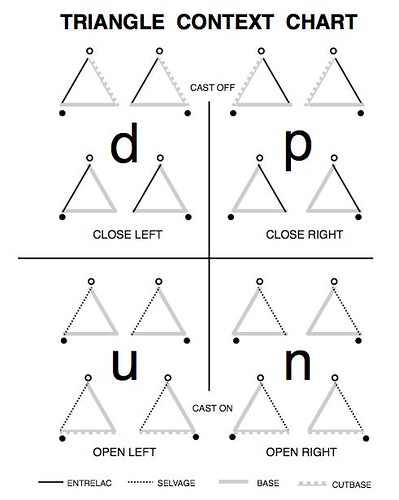
In order to go from a list of triangles to a fabric that assembles the triangles in the intended way, the knitter needs to be able to make triangles in all the possible contexts they are found in the work.

I have come up with the Triangle Context Chart as an aid to the knitter in recognizing and dealing with this small set of triangle contexts. There are in fact sixteen triangle contexts, resulting from four binary possibilities: 
  1. The triangle is either an interior triangle or an exterior triangle (the only exterior triangles are the first, the cast-on triangle, and the last, the cast-off triangle.)
  2. The yarn enters either from left or right of the triangle base.
  3. The exterior edge of the triangle (i.e., the edge that is not interior to the triangle strip) is either a temporary selvage (open) or it is an entrelac (close), meaning it picks up stitches from the selvage of a previously knit triangle.
  4. The exterior edge is on the left or the right.

Since it is obvious that the first triangle in an instruction must be the cast-on triangle, and the last is cast off triangle, the first binary possibility does not need to be explicitly stated.

Also, which side the yarn enters on is an inevitable consequence of the knitting in the preceding triangle, and the independent choice at the very start of the knitting is not usually important, so the second binary possibility can go unreported as well.

That leaves four possible contexts needing to be reported for every triangle in the knitting: open left, open right, close left, close right.  

A convenient way to write down a sequence of these four triangle contexts is with this emoticon code:

u , n , d , p .

Hint: look at the letters like smileys, but inclining your head toward the right.

I call this the undip code (accent on the first syllable of 'undip'.)

In undip, a word for the tetrahedron is:

u n d p ,

or synonymously,

n u p d .

Reference:
Gopi, M., Eppstein, D., "Single-Strip Triangulation of Manifolds of Arbitrary Topology." Proc. 25th Eurographics 2004.

Tuesday, February 23, 2010

Proving Weaving

The Plain-Weaving Theorem


Akleman, Chen, Xing, and Gross (ACXG) have published a proof that every polygonal mesh describes a plain-weaving (a term to be precisely defined below.) If so inclined, we may count two plain-weavings by considering weavings differing only in textile handedness (indicated by the helical pattern of threads around a specified opening in the fabric) to be distinct.


(Note that any weaving can theoretically be everted—turned inside-out—through an opening. While this does not alter the textile handedness of the work, it does change the handedness of the work as a whole. For example, eversion turns a right hand glove into a left hand glove. So it may fairly be said that the everted version does not weave the same surface. Nonetheless, the same set of weavers, woven in the same handedness, may weave either surface. The basket maker will need a hint to resolve this ambiguity.)


ACXG's result is fundamental. Their proof is fully three-dimensional and topological, so there can be no objections as to its physical reality. The proof leaves no escape for a compact surface of any sort -- all compact surfaces, be they orientable or non-orientable, high-genus or low, are doomed to be woven as baskets. The escapees are the non-compact surfaces, i.e., surfaces of infinite extent, or infinite topological genus, or having excluded interior points or open boundaries—but such are not buildable by any method.


And there is also no escape for any particular kind of mesh. Their result, which I will take to calling the Plain-Weaving Theorem (PWT,) states that all polygonal surface meshes describe a way to weave the surface. There is great difficulty imagining any way to subdivide a surface into local neighborhoods that is not in effect a polygonal surface mesh. Admit it or not, computer scientists are doomed to be virtual basket weavers for the rest of history.


Having this 3D theorem in hand, I want to turn to a purely 2D representation of plain weaving which is easy to visualize, easy to characterize as a mathematical object, and probably sufficient for all artisanal purposes.


The Definition of Plain-Weaving


I adopt ACXG's definition of plain-weaving—which differs from common usage in the textile field. In their definition, a plain-weaving "consists of threads that are interlaced so that a traversal of each thread alternately goes over and under the other threads (or itself) as it crosses them." This definition takes in some weaves such as the kagome (also known as open hexagonal or triaxial) weave that are not considered "plain" in the textile field, but the PWT rewards us with the insight that all plain-weaves newly defined are really the same thing and can be intermixed freely.


Weaving and Chess-Colorings


Kenneth Snelson, in the specification of his patent on 3D weaving, U.S. Patent 6,739,937, makes a significant observation: we can treat weaving as a 2D arrangement of openings rather than a 3D arrangement of threads. To turn the old saw around, Snelson is saying we should watch the hole, not the donut.


As Snelson observes, the openings in a plain-weave fabric have a handedness that can be compared with the handedness of a screw-thread. In going from over-one-thread to under-the-next whilst going around an opening, the threads have a ramp-like geometry. If we arbitrarily choose a direction of travel around the periphery of the opening, and identify that direction with the direction of the curled fingers, then using the ramps in this direction converts the advancing movement into a motion in a perpendicular direction. We can identify this perpendicular direction with the direction of the thumb extended. Uniquely only a left or a right hand is capable of carrying both of these identifications. We can therefore unambiguously label every opening in a weave as right or left, R or L, or perhaps color code them black or white. Since no reference has been made to a side of the fabric, the handedness of the openings is intrinsic to the weaving: it matters not which side we view or whether the work is everted or not.


Also, there can be no question that the threads in a plain-weave agree on the handedness of any opening they share—otherwise they would not be able to reach a mutual arrangement about whose turn it is to go over or under where they cross. Like a circle of fallen dominoes, they must all lean one way.


Snelson observes that adjacent openings (i.e., openings on opposite sides of the same thread) have opposite handedness. This follows almost anatomically: if two hands have curled fingers pointing in the same direction, and extended thumbs pointing in the same direction, they surely must be a right and a left.


A coloring of the faces of a map with two colors, say black and white, such that adjacent faces have different colors is called a chess-coloring (I prefer this shorter term over "checkerboard coloring") Not all maps can be chess-colored, but a map operation, medialization, is known which converts any map into a chess-colorable map (Deza and Dutour.) The resulting map is called the medial of the original map (itself called the primal), and the result of medialization is the same whether we start from the primal map or its dual. In map operation notation (see Diudea et al. for an explanation of the notation):


Me(M) = Me(Du(M))


This is the result reported in ACXG that a mesh and its dual describe the same weaving. As Deza and Dutour have pointed out, medialization can be applied to any map (surface-embedded graph) to produce a chess-colorable map, hence every surface-embedded graph has a plain-weaving discoverable through this map operation.


In knot theory terms, a plain weaving is an alternating link. The medial graph is the projection (or more properly the shadow when crossing information is omitted) of an alternating link. The chess-coloring of the medial graph corresponds the checkerboard-coloring of the link projection, and the primal and dual maps above are the two Tait graphs of the link projection (see explanation of terms in Dasbach and Lowrance.) Because the link is alternating it is described in full by its chess-coloring.


Mathematically the study of plain-woven baskets reduces to the study of chess-colorings on surfaces, and such a chess-coloring contains essentially all the information the weaver needs to weave the basket.


References:


Akleman, E., Chen, J., Xing, Q., and Gross, J. L. 2009. Cyclic plain-weaving on polygonal mesh surfaces with graph rotation systems. ACM Trans. Graph. 28, 3 (Jul. 2009), 1-8. DOI= http://doi.acm.org/10.1145/1531326.1531384


Snelson, K., U.S. Patent 6739937, Space Frame Structure Made by 3D Weaving of Rod Members.


Deza, M., and Dutour, M., Zigzags and central circuits for 3- or 4-valent plane graphs, http://www.liga.ens.fr/~deza/Sem-ZigCc/ZigCcConf.pdf


Diudea, M., et al., 2003, Leapfrog and Related Operations on Toroidal Fullerenes, Croatia Chemica Acta, 76 (2) 153-159, http://pubwww.carnet.hr/ccacaa/CCA-PDF/cca2003/v76-n2/CCA_76_2003_153-159_diudea.pdf


Dasbach, O. and Lowrance, A. 2010. Turaev Genus, Knot Signature, and the Knot Homology Concordance Invariants, http://arxiv.org/pdf/1002.0898

Tuesday, December 30, 2008

Convolutions as Weaving


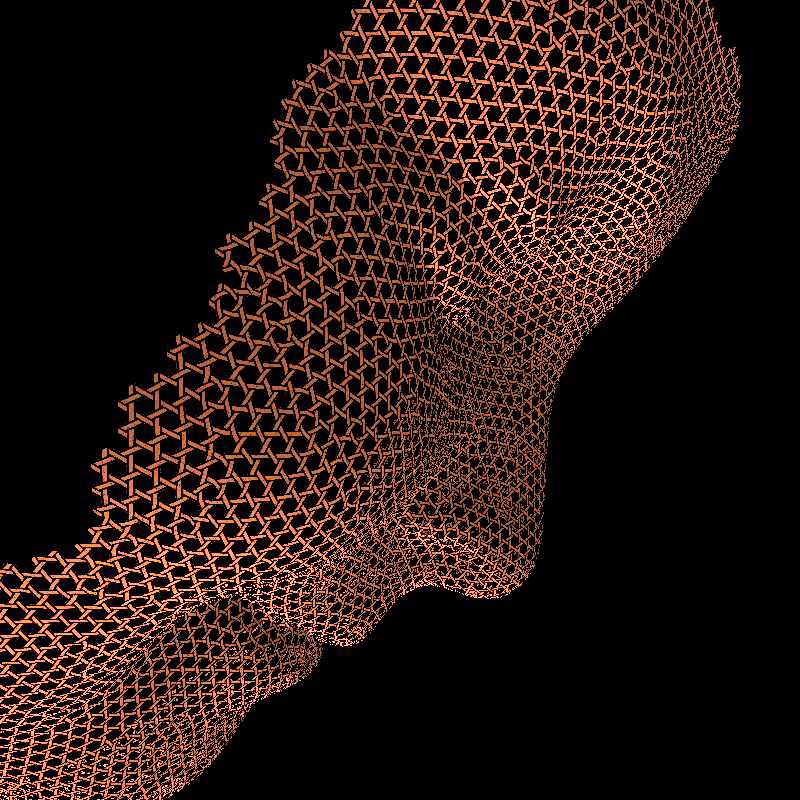
Brain contours rendered as triaxial weaving. Brain model provided courtesy of INRIA by the AIM@SHAPE Shape Repository.

Friday, December 12, 2008

One less thing to worry about.


Most of my weaving experience has been with twogs, which are very short weavers that only run from one crossing to the next. Since all the twogs are usually the same length, the only way to make the basket surface curve is to connect the twogs in rings of five or seven-- or any ring number other than six (which would produce flat weaving.) One is constantly aware of ring number when weaving twogs. What are naturally called "rings" when weaving with twogs, are more naturally called "openings" when weaving with long weavers. This view of "Olivier's Fingertip" shows that the openings do not all have the same number of sides. I am happy to report that while doing the weaving I was completely unaware how many sides were in the openings I made. Once a weaver has been started in its correct position, it can only weave one way.

Thursday, December 11, 2008

Weaving "Olivier's Fingertip"


Here I am in the early stages of weaving the sculpture "Olivier's Fingertip." Later, as the piece got bigger and deeper, I shifted to working on my lap. That's the cardboard maquette on my right for reference-- it wasn't really needed. Unfortunately the bottle of rubber cement nearby was constantly needed in the nearly losing battle to keep paper templates attached to aluminum weavers.

Weaver Paths


The path of any particular weaver is rather chaotic. Some are short, some are straight, but then there are ones, like weaver 28 in "Olivier's Fingertip," that loop all over the place. This computer-generated view is from inside the fingertip, looking toward the distal end (the fingernail is on top.) The triangle mesh could probably be edited to minimize outliers like this one, but in any case the need to be able to splice weavers is evident. All the weavers in "Olivier's Fingertip" are unspliced. Ones like 28 are a little too long.