Showing posts sorted by relevance for query voxel. Sort by date Show all posts

Tuesday, November 18, 2014

Voxel weaving versus corrugated kagome

A woven cube (a single woven voxel).

Voxel weaving and corrugated kagome are similar weave patterns. Both are made with straight weavers having 90-degree folds, in both techniques the exposed portions of each weaver are squares. Corrugated kagome always produces a corrugated surface; voxel weaving sometimes produces a corrugated surface—the exceptions are when the basket surface is parallel to the x, y, or z plane. Voxel weaving rigidly maintains angular orientation over the whole basket (i.e., each square is perpendicular to either the x, y, or z axis); corrugated kagome permits folding along the diagonal of the square (whether or not this fold is part of the corrugation pattern) so every angular orientation is possible.

A corrugated kagome unit-weaving of an octahedron. The exposed portion of each weaver is a square with a diagonal fold.

A diagonal fold in corrugated kagome corresponds to an edge in the underlying triangulation. Therefore, in flat passages with zero corrugation frequency there are not any diagonal folds. In such a passage corrugated kagome and voxel weaving are indistinguishable.

In a flat passage, zero-frequency corrugated kagome and voxel weaving are indistinguishable. The triangles are the underlying triangulation of the corrugated kagome weaving.
Since is not possible for the triangulation of a closed shape to be entirely flat, there is always some place in a zero-frequency corrugated kagome weaving where diagonal folds appear. Therefore, there is no example a closed basket that is both voxel-woven and corrugated kagome.


Where to go from here? Since a flat passage cannot a basket make, there is no way to make a basket that is both voxel-woven and corrugated kagome.

Friday, December 19, 2014

The deltahedra inside voxel-based solids

There's a tetrahedron inside every cube (and in two possible orientations.) (Image quoted from  http://burrtools.sourceforge.net/gui-doc/Spacegrids.html )
There is a tetrahedron inside every cube or voxel: its edges are six face diagonals. There are two possible orientations for the tetrahedron as there are two consistent sets of face diagonals. If every unit-cube voxel of Cartesian coordinates (x, y, z) is assigned the parity of x+y+z, and tetrahedron orientations are assigned according to this parity, neighboring tetrahedra always meet edge to edge.

In this way a vox solid (voxel-based solid) can be converted into a deltahedron (a solid faceted exclusively with equilateral triangles) that lies entirely within the original vox solid.

A structural problem arises with this technique. For example, a rigid stack of voxels becomes a flexible chain of tetrahedra.

The tetrahedra that lie inside a rigid stack of cubes form a flexible chain. (Image quoted from http://www.kaleidocycles.de )

A solution to this structural problem is to divide each voxel into eight sub-voxels, and replace those sub-voxels by tetrahedra. Here again there is a parity choice, one that makes these eight tetrahedra either a stella octangula or a "cumulated cuboctahedron."

A "cumulated cuboctahedron" (shown in red) inserted between the two halves of a stella octangula (gray.) (Image quoted from http://the-arc-ddeden.blogspot.com )

If stella octangula voxels are used, the corners are prominent. Using cumulated cuboctahedra (which can be imagined by slicing a half-voxel margin off this object) results in bevelled corners.
Whether the stella octangula or "cumulated cuboctahedra" units are chosen, weaving their surface triangles in corrugated kagome (a.k.a., knotology) restores the missing cube corners of the sub-cubes—the woven piece resembles the original vox solid externally, but its internal structure is a little different.

Friday, December 5, 2014

Pop goes the voxel

A collapsible voxel: the triangles have an altitude/base ratio of 0.55.

The same voxel reassembled with its pyramids "pushed" inward.

The voxel partially collapsed.

The voxel fully collapsed.
A collapsible voxel like this can be woven using weavers that are just slightly crooked.

Wednesday, December 31, 2014

The difference between voxel weave and universal weave of a square grid

The difference between the voxel weave and the universal weave of a square grid—it's all a matter of where folds and cuts may be made.
The difference between the voxel weave of a square grid and its universal weave is simply a matter of where folds and cuts are permitted.

In the universal weave, the edges of the underlying graph are presumed to trace all possible locations of folds and cuts, just as they would in a mesh. This is so even though the underlying graph contains only black vertices (i.e., it locates fabric holes of only one parity.) Holes of the other parity will be interpolated by medialization, but these interpolated vertices are off-limits to folding and cutting.

In voxel weaving the same grid, the underlying graph is of course the same, but we are now also given geometric data on the white vertices (i.e., fabric holes of both parities are already located in 3D space.) In effect, we get to start with the radial of the underlying graph, and folds and cuts are permitted only along its edges which exclusively connect holes differing parity.

The 45° rotation between the two square grids of allowable folds and cuts, causes the modulus to be √2 larger in the universal weave. The fabric itself is identical.

In a plane of voxel weave, at a location where four diagonal creases can meet to form a square, a tube of square cross-section in universal weave can be woven in. This kind of join in effect permits the smaller right triangle in the knotology weaver to be used to transition between the two allowable-folds meshes.

Knotology weavers

Pattern for a knotology weaver.
A knotology weaver can weave mixes of tabby weave, corrugated kagome, and voxel weaving. Remarkably, all these weaves are woven with 100% fabric coverage using the same pattern of potential folds (not all potential folds necessarily being used in any given passage.)

The pattern of creases in a knotology weaver (see image above) can be described as a right-angled triangle wave with "altitudes" dropped from each apex to the sides of the strip. These two categories of creases are termed diagonal (solid lines in the image above) and perpendicular (dashed lines.)

Voxel weaving only ever uses the perpendicular creases.

Tabby weave, when done according to the universal method (i.e., with a hole in the center of each square and weavers running at 45°) does not use the perpendicular creases at all; it only uses the diagonal creases when passing over an edge (e.g., one of the 12 edges of a cubical basket.)

Corrugated kagome always uses the perpendicular creases (at fold angles of ±90°) to form its peak or dell caps, and uses the diagonal creases (at varying fold angles) when passing between two triangles of the same salience (i.e., peak-to-peak or dell-to-dell) or when crossing over an edge (e.g., one of the 6 edges of a tetrahedral basket.) When passing between triangles of opposite salience the diagonal crease is not folded.

The squares in voxel weaving have sides equal to the weaver width; the squares woven in universal tabby weave have sides equal to the length of the diagonal creases—larger by a factor of √2. Corrugated kagome must meet voxel weaving essentially at a truncated cube corner. Corrugated kagome must meet universal method tabby weave essentially at an octahedron equator.

Thursday, December 4, 2014

Voxel-based surfaces are completely foldable

The boundary surface (vox surface) of any vox solid (i.e., a voxel-based solid) is a quadrangulation. Any such quadrangulation is bipartite because the edges and vertices in a three-dimensional packing of cubes form a bipartite graph and our quadrangulation is merely a subgraph of this.

Since the quadrangulation is already bipartite, we can convert it into a tripartite triangulation by placing a vertex of a third color in the center of each quadrangular (actually square) face, and connecting an edge to each of the four surrounding vertices.

Once triangulated in this way, a voxel-based surface is completely foldable because its tripartite.

Wednesday, December 3, 2014

Unit-weaving voxel surfaces

A unit-weaving pattern for the enveloping surface of a union of voxels. The weavers are four squares long. The black squares are holes in the fabric. The dashed lines are voxel boundaries. (Alternatively, the corners of the voxels could be centered on the holes.) In either case, if the weave pattern is made up of unit squares, the modulus of the votels is the square root of 5. 

The over-and-under of weaving can play tricks on the imagination—for example, when weaving a non-orientable surface like a Klein bottle. The reliable way to picture an over-and-under weave is as a chess-coloring of a four-valent map. (A map is a generalization of a polyhedron we are no longer concerned with measurements of angle and distance, i.e., geometry, but only with the way the polygonal faces are mated with each other and the way the surface connects to itself; i.e., we are only concerned with topology.)

Starting with any map we can convert it to a chess-colorable, 4-valent map via the map operation medial. In this way we can discover a way to weave any tessellation of any surface, orientable or non-orientable. That's the universal method.

For special maps there may be alternative ways to do the weaving. For example, if the original map is already 4-valent and chess-colorable there is no need to take its medial, the original map is directly weavable. The dual of a 4-valent, chess-colorable map is a quad-faced, bipartite map. Thus, if we are given a quad-faced, bipartite map we do not need to take its medial—we can simply take its dual and weave that. As an example of the difference the choice makes, consider the map of a cube: it has 6 quad faces and its vertices can be colored black and white in such a way that no two adjacent vertices have the same color (in other words, the map of a cube is bipartite.) If we weave the map of a cube using the universal method we will end up with one weave crossing for every edge in the original map: a total of 12 weave crossings. If we use the special method (i.e., we directly weave the map's dual) we will end up with a crossing for each face in the original map: a total of 6 crossings. The special method yields a coarser and simpler way to weave the same surface.

A commonly encountered surface that is quad-faced and bipartite is the envelope of any union of voxels. Clearly such a surface is quad-faced. It is also bipartite because the entire 3-D, Cartesian mesh of unit squares is can be vertex 2-colored such that no two adjacent vertices have the same color. When we sculpt a union of voxels out of this space, the vertices can keep their colors. Left in view is a surface that is clearly bipartite.


Alternate ways to unit-weave a voxel whose modulus is the square root of five times the weaver width.


Tuesday, March 31, 2015

The Adams "World in a Square" projection and knotology weaving

The square module of Adams's "World in a Square II" conformal projection of the globe is similar to the square module of knotology weaving.


A Belyi function maps an orientable surface to the sphere with at most 3 singular points (critical values.) The pre-images of these points on the orientable surface are called critical points. In the general case, the critical points form an Eulerian triangulation of the orientable surface (a triangulation with an even number of triangles meeting at each vertex.) The smallest such triangulation has just two triangles: it is, so to speak, a triangular envelope.

From a number theorist's point of view, the three critical values on the sphere should be located at 0, 1, and infinity in complex (Riemann sphere) coordinates. These points on the Riemann sphere share a great circle (the real axis) at spacings of 90°-90°-180°. The Adams "World in a Square II" projection also has critical values along a great circle (the extended prime meridian that includes 180° longitude,) and they are also spaced at 90°-90°-180° (the South Pole, the Pacific Point, i.e., the antipodes of the longitude/latitude origin, and the North Pole,) so the correspondence is pretty exact.

The several appearances of the extended prime meridian in Adams's projection (the four sides of the square plus a diagonal of the square) show that Adams's projection is really two triangles joined along a shared edge. The four corners of the square fall into two classes: those that are composed of a single triangle angle (the two appearances of the Pacific Point) and those that are composed of two triangle angles (the North and South Poles.) Each triangle angle represents 180° on the earth's surface (the angle between two segments of a straight line is always 180°) so the North and South Poles each represent a pair of triangle angles, 2 x 180° = 360°, or a full turn. Each of the two appearances of the Pacific Point represent a single triangle angle, 1 x 180° = 180°, or a half-turn.

A "World in a Square" knotology weaver folded the natural (prime-median) way.

The way nature intends us to fold Adams's square is along the prime meridian: that turns the square into two triangles with every triangle corner = 180°. The unnatural way is to fold the square along the equator, then the right-angled corners at the poles represent 360° on the earth (each being actually two triangle corners), while the 45° corners represent 90° on the earth (each being 180° on the earth split down the middle by the fold.)

Nature's way requires an Eulerian triangulation (just as we would expect in a Belyi surface;) ensuring that every vertex of the triangulation gets an integral multiple of 360°. The unnatural way allows any number of triangles at the "rangles," the places where right angles (each representing 360° of earth surface) meet, but the price is that we need doubly-Eulerian vertices (multiples of four triangles) at the "nooses," the places where the 45°-angles (each representing 90° of earth surface) meet. That sounds strange, but it is actually convenient to the way knotology weaving is frequently done. Often, we are weaving a deltahedral surface that is, so to speak, omnicapped by cube corners, so we need an odd number of triangles (3) at the rangles. Getting doubly-Eulerian vertices for the nooses may sound difficult, but, since every each omnicap contributes a pair of triangles to that vertex, the underlying deltahedral triangulation only needs to be Eulerian.

A "World in a Square" knotology weaver woven the unnatural (equatorial) way.

In weaving the enveloping surfaces of vox-solids the placement of the oblique knotology creases are irrelevant as they are not folded, but the number of squares around a vertex can be 3 (the head of a corner,) 4 (flat ground,) 5 (the corner of a building rising from flat ground,) and 6 (a square well touching corners with a building rising from flat ground.) Those odd numbers—3 and 5—cause problems for the Pacific Point since it supplies only half-a-turn at each corner of the square. For example, we cannot "world-weave" the surface of a 1-voxel cube because the Pacific Point would be forced to make an appearance at certain "heads of corners;" but, we can world-weave the surface of an 8-voxel cube if we place Pole Points at the corners, thus keeping the Pacific Point safely in the middle.

A portion of the enveloping surface of a vox-solid.
It is interesting to note that an 8-voxel knotology cube can be viewed as a deltahedron omnicapped with cube corners, the underlying deltahedron is an octahedron—and the surface of an octahedron is indeed an Eulerian triangulation. Any vox-solid we make out of these larger "octo-voxels" can indeed be world-woven.

Wednesday, August 2, 2023

Hill-and-valley weaving of voxel object surfaces

Hill-and-valley weaving must follow the medial of a bipartite map. The skeletal surface graphs of voxelized objects (example above) are bipartite. Pasting the truchet tile (below) onto each square face (with corner colors matching) gives a face 3-coloring of the medial graph (the new edges trace the boundaries between colors).

For example, for a single voxel, i.e., a cube, decorating its six faces with the truchet tile, shows that its 3-colored medial is a cuboctahedron (below) with its square faces colored 'saddle' and its triangular faces colored alternately 'hill' and 'valley'.

A spherical cuboctahedron (see below; art by Watchduck) is four great circles in an arrangement of maximum symmetry, so the smallest angles between these planes is equal to the dihedral angles of the tetrahedron, or approximately 70.5288 degrees.

To weave the cuboctahedron weave 'flat' (i.e., without hills and valleys) weavers must cross each other such that the internal angles of the triangular faces are about 70.5288 degrees, a bit wider than the 60 degrees these angles would measure on the plane. To make the triangular faces into hills and valleys, and, correspondingly, the square faces into saddles, we need even wider internal angles in the triangular faces. Below is a hill-and-valley weaving of the cuboctahedron with 100 degree internal angles in the triangular faces. Because of the hills on alternate triangles of the cuboctahedron, the basket appears strongly tetrahedral.

Wednesday, December 3, 2014

Voxel unit-weaving with singly-folded weavers

Expanding the 'missing corner' pattern a little bit reduces the number of folds.
By expanding slightly the 'missing corner' pattern it is possible to reduce the number of folds in each weaver from three to one. The angular rotation needed to accomplish this is 22.5 degrees (pi/8 radians.)

When weavers need to be bent before weaving, having a single fold greatly reduces the parts inventory.

The 'missing center' pattern has no such solution: it always requires triply-folded weavers:

The 'missing center' pattern always needs triply-folded weavers.
Model of a cube (a single voxel) loop-woven with singly-bent loops.
There are only three bend states for singly-bent loop weavers: bent convex, bent concave, and unbent. Manufactured loops of those three types suffice for weaving any voxellated surface.

Thursday, December 11, 2014

Weaving tetrakis vox surfaces

Another way to deal with the lack of surface corrugation on some vox solids is to corrugate each exposed voxel . When the corrugation takes the form of a square pyramid added to each exposed voxel face, the adjective tetrakis, usually applied to polyhedra, can be applied to the vox surface.

A parameter is the height of the pyramid, or, what is easier to measure, the altitude/base ratio, a/b, of its isosceles triangle faces.

When a/b = 0.5, the pyramid has zero height: we have a cube that has been decorated with crossing diagonals. The universal weave of a cube naturally produces this shape with its four straight weavers crossing on every face.

When a/b = √5 / 4 = 0.5590, all the dihedral angles are equal and we have a tetrakis hexahedron. The weave is the same as the universal weave of the cube, but the weavers are a little crooked. This is an appropriate a/b for folding.

When a/b = √2 / 2 = 0.7071, the original cube edges momentarily disappear and we have a rhomic dodecahedron. This is the tallest pyramid we can use without encountering mechanical interference at sharp internal corners. Again, the weave is the same as the universal weave of the cube except that the weavers are crooked and, in this case, some folds are missing, leaving rhombic rather than triangular facets.

When a/b = √3 / 2 = 0.8660, the facets are all equilateral triangles. The vox solid cannot have any internal corners—assuming it does not, the resulting  tetrakis surface is a deltahedron.

All the weaves described here are coarse weaves: the universal weaves of these shapes would require a fabric opening in the center of each triangular facet.

All of these tetrakis vox surfaces are in theory completely foldable (the rhombic dodecahedron would need to permit folding along its short diagonals.)


Thursday, August 11, 2022

Fold-up baskets and 3-connected planar quadrangulations

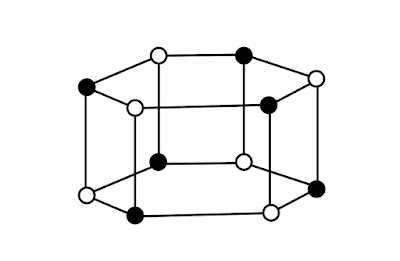
Physical surfaces like paper are more restricted in folding than mathematical surfaces because physical surfaces cannot pass through one another or coincide. Perhaps there are maps on the sphere where no physical (a.k.a., self-avoiding) folding of the corresponding fold-up basket is possible? In limited experiments, it seems more common that no un-folding is possible. An example is the skeletal map of a hexagonal prism. This map is bipartite and polyhedral (planar and 3-vertex connected) so it should have an unfolded configuration containing positive volume; however, when assembled from 45-90-45 triangles in a flat configuration, it is seemingly impossible to fully unfold the surface because the two 6-sided faces (each with 6 right angles around the face center) are too hyperbolic to be happy in the unfolded configuration.
bicolored hexagonal prism

Similarly, maps that are only 2-connected (maps derived by inserting white vertices in edges can be no more than 2-connected) will have at least some portions that contain zero volume--even when fully un-folded--unless triangular faces are deformed to non-planarity (example below).

surface model with triangular faces deformed to non-planarity

These observations draw attention to the 3-connected planar quadrangulations (3CPQ's,) which are maps that are polyhedral and quad-faced, as the best candidates for fold-up baskets. Voxel surfaces without topological holes (top image) are a familiar example of this class.

Some basic properties of quadrangulations and 3CPQ's in particular:

Planar quadrangulations are necessarily bipartite.

A simple (i.e., no loops or parallel edges) planar quadrangulation has connectivity either 2 or 3. Note in this regard that the path of three vertices (below) is not considered a simple planar quadrangulation.

bicolored path of threee vertices

3-connected quadrangulations are necessarily simple.

Given 1 of its 2 possible bicolorings, a planar quadrangulation is the radial of the underlying, pre-radial map revealed by drawing the black-vertex to black-vertex diagonal in each quad, and then erasing the original edges. The pre-radial will always be planar; but might not be 3-connected, simple, or bipartite. The pair of pre-radials derived from alternate bicolorings of the same quadrangulation are dual maps. If there is a face in the pre-radial whose boundary walk is not a cycle, then the radial has multiple edges.

A 3CPQ has at least 8 vertices of degree 3.

The smallest 3CPQ is the cube (8 vertices.)

There is no 3CPQ with 9 vertices. The only 3CPQ with 10 vertices has sparse6 code, “:I`ACPpaIOyFJSxn”. (Sparse6 codes can be viewed at the Sage Cell Server.) This object is known as the pseudo-double wheel of 8 faces, or W8. Notice that the cube can be seen as W6, and it is the smallest pseudo-double wheel that is 3-connected.

pseudo double wheel of 10 faces

Sparse6 codes for 3CPQ's can be generated at The Combinatorial Object Server which uses Brinkmann and McKay's plantri software.

There is just one 3CPQ with 11 vertices: ":J`ACPpaIOxsOUiBe".

Among the three 3CPQ's with 12 vertices is ":K`ACGcaMGhBeQiRUO^", a.k.a., the double cube.

double cube
The number of 3-connected planar quadrangulations with n faces forms integer sequence A007022 in the Online Encyclopedia of Integer Sequences. The maps dual to 3CPQ's are simple, 4-regular, 3-connected planar maps: the same integer sequence counts those with n vertices.

Friday, December 12, 2014

Weaving surfaces based on tetrahedral-octahedral voxels

Assembly of the tetrahedral-octahedral honeycomb. (Image quoted from TED-43, Wikipedia)


I've missed the obvious. The easiest way to obtain an all-equilateral-triangles surface approximating a given shape is to voxelize the shape in a hybrid voxel system containing tetrahedral and octahedral voxels: the tetrahedral-octahedral honeycomb.

The resulting equilateral surface can be woven directly in kagome with straight weavers:

Any equilateral surface (deltahedron) can be woven in kagome with straight weavers.
Or, each triangle can be decorated with a cube corner (either inward or outward facing) and the result can be woven in korgome (corrugated kagome) with straight weavers and nearly 100% coverage:


Any equilateral surface (deltahedron) can be woven in korgome (corrugated kagome) with straight weavers.

Images of corrugated kagome from www.origami-guide.com .
The coarse weaving of the cube is identical to the korgome weaving of the tetrahedron.

Adding cube corners to the faces of a tetrahedron yields a cube. 
Cubic and TO (tetrahedral-octahedral) voxels use the same grid. We can make a TO surface by performing local surgery on a cubic vox solid, but that will not get us anywhere if a korgome weave just resurrects the coarse weave of the cubic vox solid.

A squares and equilateral triangles tiling. (Image quoted from http://www.microscopy.ethz.ch/tate.htm )

Tilings of squares and equilateral triangles can easily be converted to all-equilateral-triangles by adding (or subtracting) octahedron caps at the squares.

A complex tiling of squares and equilateral triangles. (Image quoted from http://www.microscopy.ethz.ch/tate.htm ) 
 When octahedron caps are side-by-side, a tetrahedron can be added between them to form a ridge.

A quasiperiodic tiling of squares and triangles. (Image quoted from Michael Baake, "A Guide to Mathematical Quasicrystals.")

The korgome weave of an octagon cap can have any combination of in and out cube corners.
Korgome weaving of the octahedral caps leaves open the possibility of whether the quadrants will be in or out, and whether the overall shape protrudes or recedes from the surface. All-out and protruding turns an isolated square into a little toadstool in a field of cube corners. (When squares are adjacent they cannot both have this toadstool form.) All-in and protruding looks like a fold-up traffic barrier. Rows of squares (these are evidently quite common in tantalum telluride quasicrystals) when filled in with tetrahedra, become korgome ridges or grooves.