|
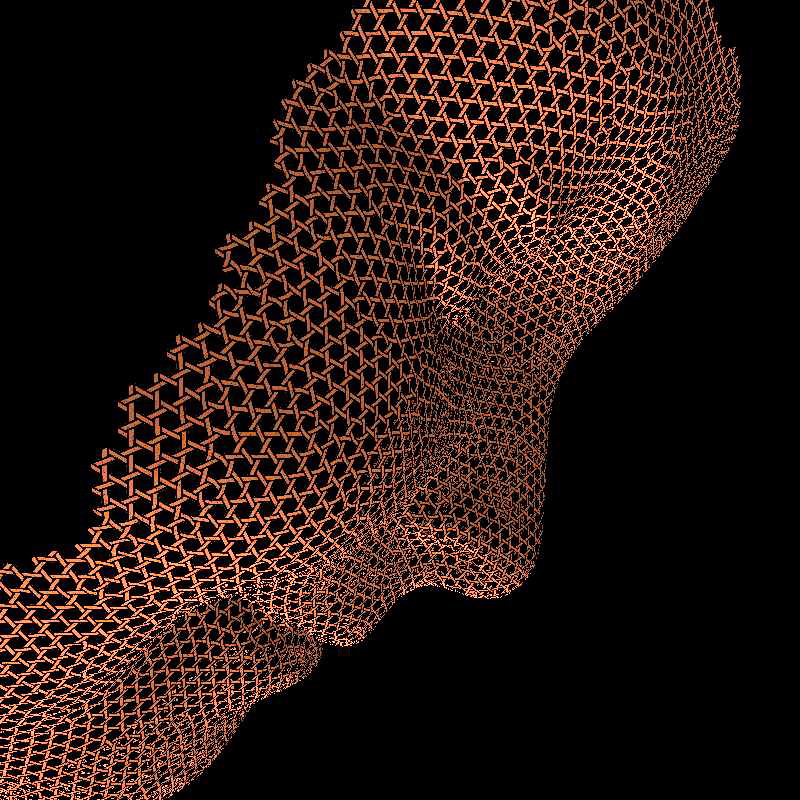
| This 2-ply, unwound from a 3x2 compound helix, exhibits a 3:1 frequency ratio. |
Friday, June 30, 2017
Counting frequency ratio in a compound helix
The easiest way to count the frequency ratio in a compound helix is to count (starting from zero) the outward appearances of a single sub-strand in full major helix wavelength, and then subtract one for the counter-rotation effect of following the major helix.


Pitch angle = pitch angle
In ordinary-lay compound helices, a stable configuration tends to occur when the pitch angle of the major helix equals the pitch angle of the minor helices. For example, the case below of a 3x3 compound helix: the 70 degree pitch angle (measured from the equatorial plane) of the major helix matches that of the three 3-ply strands. The frequency ratio in the 3x3 compound helix is 2:1. The equality of pitch angles together with the counter-rotation of the ordinary lay, make exposed strands look like they run straight along the rope.

 |
| 3-ply strands with 70-degree pitch. |

Compound 3x3 helix with 70-degree pitch.
Thursday, June 29, 2017
First attempt at 3x2 Z's in 12 gauge steel
These were formed from dull galvanized 12 gauge steel wire pretwisted to about a 60 degree angle (too much it proved). Some surface fracturing in the final shape, not elastic enough, and very hard to work by hand.


Possible non A-Trail vertices for Twongs and Z's
In the simplest, most versatile versatile vertex for Twongs and Z's, each element twines with its immediate clockwise neighbor, as in this three-talent vertex:

But there are other possibilities that may be useful:


But there are other possibilities that may be useful:


Twongs flashback (bending)
Continuing the forming details for the 9-gauge 2-ply 'Twongs' presented at 2010 New York Maker Faire:
 |
| Schematic for bending |
 |
| Bending jig in use |
 |
| Completed bend |
 |
| Completed Twongs |
 |
| Twongs ready for the Faire |
Twongs flashback (cont.)
Continuing the forming details for 'Twongs' 2-ply helices presented at 2010 New York Maker Faire:
 |
| Gauging half-wavelength during the twining process |
 |
| Completed 2x1 twines of 9 gauge galvanized steel wire |
 |
| Untwining jig |
 |
| Powered untwining |
 |
| Cutting |
 |
| Smoothing cut ends with a grinding wheel |
 |
| Smoothed end |
Twongs Flashback
I presented a 2x1 helical wire construction set called Twongs at the 2010 New York Maker Faire.
 |
| Four twongs formed from 9 gauge galvanized steel wire |
 |
| Untwining the 2-ply in the forming step |
 |
| Partially completed twong vertex |
 |
| Completed twong vertex |
 |
| As purchased wire |
 |
| Wire being partially straightened winding "the other way" against a 18.5" radius template |
 |
| Winding end of manual twiner |
 |
| Sledge end of twiner |
 |
| Man at work |
Subscribe to:
Posts (Atom)