Friday, June 28, 2013

Phase-correcting splices in puck weaving

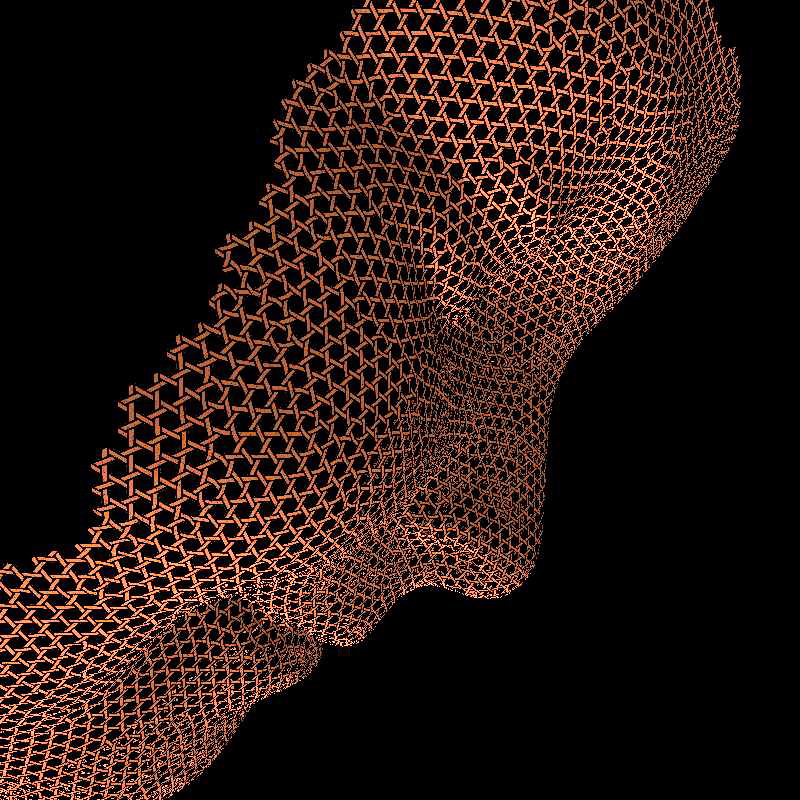
A phase-correcting splice in puck weaving.

If an error is made, or the basket weaving is improvisational, the problem arises of joining two out-of-phase sections of composite weaver. These situations always arise in pairs—if you switch to the wrong phase in one place, you are going to have to switch back again before you come around the loop.

A way to do this is shown above. It does not compromise the strength, but adds one ply of thickness in two non-adjacent squares. Since corrections come in pars, each error causes one extra puck to be added to the work.

Thursday, June 27, 2013

Puck weaving the dodecahedron

The skeleton graph of the dodecahedron is not bipartite, so, despite its high symmetry, making a dodecahedral basket is a project that introduces the real housekeeping chores of puck weaving.

We have a goal to finish at an all-outboard vertex in order to make the closing moves easy and familiar. More burdensome, we must keep track of all the Petrie paths in the basket to insure that we phase them consistently (i.e., should we place the next "unprecedented" puck centrally or outboard?). As far as the absolute phase goes, we only care about the three targeted Petrie polygons that intersect at our terminal vertex. For all the other Petrie polygons, we only care that we phase them consistently. Should we fail to do so we'll come to a non-sequitur in the weaving.

A vertex on the dodecahedron happens to have an antipodal vertex where the same three Petrie polygons also intersect. Since the half circumference of a dodecahedron (taking its Petrie polygons to be geodesics) is 5 edges, an odd number, an all-outboard vertex on the dodecahedron will always have an all-central vertex at its antipodes. Unfortunately, since we must keep track of the phases of all of the Petrie polygons anyway, this property does not really make the puck weaving of a dodecahedron any easier. 

The best working method seems to be to mark up an undip word for the dodecahedron with the correct phasing of the "unprecedented" weaver to be added at each open letter. Since central phasing seems a natural default, I mark open letters with a prime if the phasing of the unprecedented weaver is outboard. The whole weaving must be calculated in advance to get this right. Below is an example worked out by hand for the dodecahedron.


The three Petrie polygons that intersect at a vertex on the dodecahedron also intersect at its antipodes.

The phasing of all of the Petrie polygons must be calculated before weaving can begin. The pink line marks the Hamilton path traced by the undip word. The Petrie paths follow the crossovers (half-twists) at the midpoint of each edge. Each Petrie polygon has been labelled with a consistent alternation of 'c' and 'o' phasing (central and outboard.)

The undip word with its housekeeping markup is unnndn'unu'uu'pppdpdpdd .

Wednesday, June 26, 2013

Aluminum puck-woven cube


This cube was not made using an undip sequence. The working was crowded due to the need to pre-bend the springy aluminum sheet metal to approximately the final angle of its diagonal folds. It proved more practical to complete an all-central vertex at the "south pole," secure it on the outside with duct tape, add all possible extensions to that vertex (6 of them), and then weave in an equatorial belt of 3 puck weavers. That accounted for all 12 pucks. All that remained was an all-outboard vertex to be closed at the "north pole."


Increasing the radius at the rounded corners to about 0.5 cm helped in closing the outer flaps at the last vertex. 

Puck weaving from undip words

When puck weaving from an undip word, we build out a triangulated surface one triangle at a time, one triangle per undip letter. Half of those letters are "open", the other half are "close" letters. 

Each finished triangle is 4 plies thick. Each 4-square puck weaver effectively covers 4 * 2/3 triangles with a single-ply thickness. So, on average, we need to add 1.5 unit weavers per letter. (That checks since there is one undip letter per vertex in the primal map, and we already knew that we need 1.5 unit weavers per vertex.)

A possible weaving strategy is to add 2 puck weavers at each "open" letter, and 1 at each "close" letter. As an exception, add 3 puck weavers at the first letter (which is invariably "open") and 0 at the last (which is invariably "close."). This strategy always yields  1.5 puck weavers per letter.

4-square puck weavers extend pretty far. One placed centrally extends half-way through it's neighbor's neighbor; one placed "outboard" extends (on its longer side) half-way through its neighbor's neighbor's neighbor. These long extensions can make puck weaving visually complex compared to simple unit weaving, so it is desirable to have definite placement rules to follow. 

Bipartite maps are the simplest to weave. If we always shingle composite weavers the same way (the standard way is with the leading strokes of the w's in front,) then every all-central vertex will be identical, and every all-outboard vertex will be identical. If the primal map is bipartite, then it is possible to have just these two types of vertex in the basket. Such a solution is found simply by making these two types alternate around any cycle, for example the Hamilton cycle encoded by an undip word. This alternation in types will occur automatically along the length of any composite weaver, we only need to be careful when placing crossing pucks to avoid creating a hybrid vertices.

If we would like an undip word for a bipartite basket to terminate at an all-outboard vertex, we simply need to start it at an all-central vertex. 

Each woven peak can be characterized as "upstairs" or "downstairs" by circling around the peak in a counterclockwise direction and noticing the "steps" where each weaver underlies or overlies the next. This determination can be made on either side of the fabric and gives the same result. When composite weavers are shingled the standard way (with the leading stroke of the w in front) only "downstairs" peaks are correctly woven. Weaving correctly automatically assures that the flaps of the pucks are hidden on both faces. 


Sunday, June 23, 2013

Oriented weavers: teleological weaving

Kagome weaving. In polyphase unit-weaving each of these weavers would have a specified direction (orientation.)

Polyphase weavers have a structure similar to fallen-over dominoes. This structure gives the composite weaver a definite directionality or orientation.

Weaver paths can wander all over a basket, sometimes crossing over themselves. In some cases a single weaver constitutes the whole basket.

The weaving elements used in traditional basket making have an orientation—the direction that the plant material, say rattan or bamboo, grew—but it is not usually a concern in weaving. A composite puck weaver has an orientation too.  The structure of a composite weaver is like a row of dominoes that has fallen over. Just as we can tell in which direction the dominoes fell, the structure of a composite weaver has a definite orientation. Either orientation will work fine in the weaving, so orientation would not be a concern if we were to make the whole weaver in one step. The problem is that we will be building small portions of weaver at a time, and generally not knowing which weaver we are working on. The only solution is to have complete foreknowledge of the basket being woven so that the orientation of each unit weaver being placed can be specified.

When weaving by undip code, we add one triangle at a time to the completed work. The triangle depicts three segments of weaver. The orientation of two segments are already fixed because  they also appeared in the preceding triangle. If the letter for the triangle is a close letter, then the orientation of the third segment is fixed by its appearance in the older triangle that is being closed to. Thus the orientation of the weavers in puck weaving requires the addition of one bit of information to each open letter in an undip code.

Friday, June 21, 2013

Opening and closing at an all-outboard vertex

At an all-outboard (mmm) vertex, the six unit weavers appear as two sets of three "flaps."

The three flaps on the outer face open like a cardboard box tops, as though a box had three tops, all arraged with rotational symmetry around a corner.

Opening an outer flap at an all-outboard corner.

Opening the third outer flap.


Opening the three outer flaps leaves a flower-like arrangement with three inner flaps still closed in the center in a reciprocal, nexorade-like pattern. Simply lift these up.

Opening the three outer flaps reveals a flower-like pattern with the three inner flaps still closed in the center.


Making puck weavers from aluminum flashing

A puck weaver made from aluminum flashing.

Cut strips that are about 0.05" narrower than the intended distance, s, between the "square" folds (in the pictured weavers s = 2.5". The strips should be at least 4s long.

Make the square folds, trimming off any excess beyond the fourth square. When folding begin in the middle and work outward—never reaching the edge. Never press closer than about 1/4" from the edge to prevent bending the edge in too sharp a radius.


After cutting and making the square folds.

Make one set of diagonal folds, ideally, due to the narrowed width, these should follow a 45-degree line and fall just short of intersecting the square folds. (Intersecting folds over stress the metal.) If the piece is flipped over so that the square folds show as mountain folds, the diagonal folds show as valley folds. Note that you must skip a square when making these two diagonal folds.

After the first set of diagonal folds.

Now make the remaining two diagonal folds which are aligned 90 degrees to the first.


After folding.

With scissors or tin snips round off the four corners.

After rounding the corners.

Theoretically you should adjust the square folds to a 90 degree dihedral angle and the diagonal folds to a 70.5 degree dihedral angle, but you may want to compromise with your intended surface. The final state of the square folds will always be 90 degrees of dihedral angle, but such tight bends may be difficult to work with in a very small basket. The final angle of the diagonal folds will vary with surface and whether you are working points in or points out.