Friday, October 7, 2011

Assembling tensegrities from undip words

An undip word specifies a step-by-step procedure that reassembles a spherical map from its edge-rhombs (the quadrilateral faces into which the map operation radial, Ra(), would dissect it.) If a map is a triangulation of the sphere, and its dual is hamiltonian, then there is a least one undip word that reassembles the primal map from its edge-rhombs. (In the special case that we obtained the triangulation as the meta, a.k.a. barycentric subdivision, Mt(), of another map, we are guaranteed that the dual is hamiltonian.)

The assembly procedure does not care what we might have drawn on the faces of the edge-rhombs, and, since many structures and machines can be represented as truchet tiles drawn on edge rhombs, an undip word is also a step-by-step guide to the assembly of any such structure or machine.

In the following I'll assume the reader is familiar with the procedure of reading an undip word to weave twogs into baskets as described in Make a Basket from a Word.

Edge-rhombs are topological objects that can be stretched in any way we wish, but it will forestall confusion if we idealize edge-rhombs as the rhombic shape created by joining two equilateral triangles at a common edge, and further assume that an edge of our primal map (the triangulation) forms the longer diagonal. Therefore, an edge of the dual map (a cubic or trivalent map) forms the short diagonal.


TWOGS through the state of play "uun—"

In order to represent the "assembly" of a twog weaving, I have made a set of paper edge-rhombs with the short diagonal marked in each of three colors. In the photographs below, green is the "photon color" and blue and pink are the "energy colors."

An undip word gains a half edge for free at the beginning of the word, and another half edge for free at the end of the word (the last being the other half of the first.) These moves are encoded, not by a letter, but simply by the fact that the word begins and ends. In reassembling edge-rhombs, we show this peculiar opening move by playing just half of an edge-rhomb (i.e., from an edge-rhomb sliced in two along its longer diagonal.)


The first letter is either a u or n, let's say u. That says, "emit a photon to the left, and then build on to the right." The photon edge will not be completed until later when it gets "absorbed." We show the state of incompletion by placing just half an edge-rhomb on the photon side while building on with a full edge-rhomb on the electron side. If our edge-rhombs have been decorated as truchet tiles, we can now physically build everything that is fully drawn at this state of play. All else must wait until more tiles are added or joined.


Below, edge-rhombs decorated as twogs are carried through to the state-of-play uun.


Suppose the next letter is d. One can visualize how a half a photon rhomb will be added on the left side of the last played rhomb and then joined to another half photon rhomb already in the work.

That's pretty much all there is to reassembling a map from an undip word that codes it.

Below are four tensegrity patterns also taken through to the state of play uun—.


ZIG-ZAG TENSEGRITY through "uun—"


CIRCUIT TENSEGRITY through "uun—"


STAR TENSEGRITY through "uun—"


DIAMOND TENSEGRITY through "uun—"


Wednesday, October 5, 2011

Tensegrities from Maps


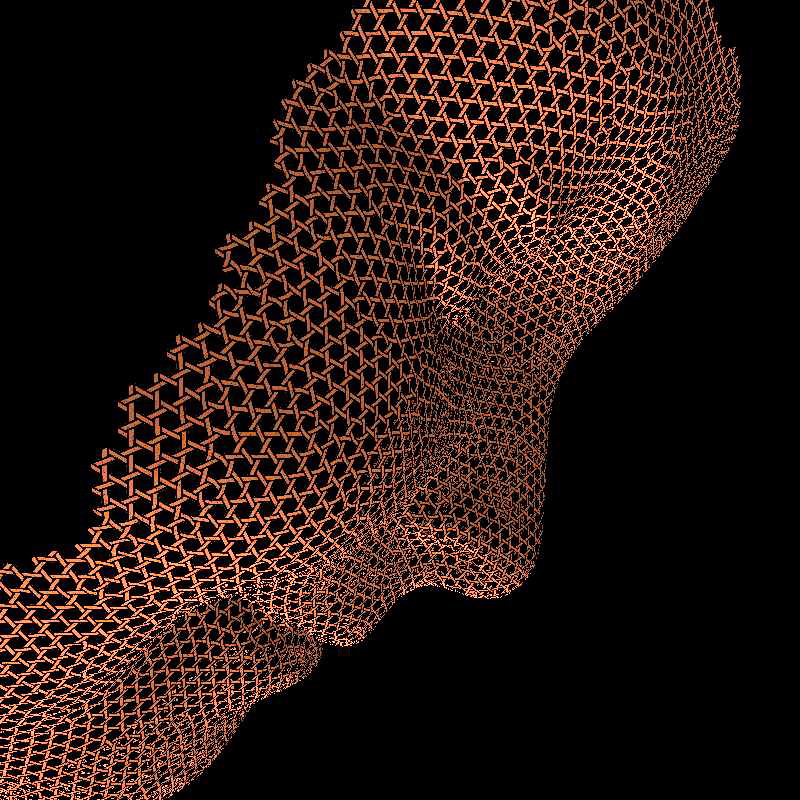
Anthony Pugh in his book An Introduction to Tensegrity, identifies three categories of tensegrity patterns: diamond (also known as rhombic), zig-zag, and circuit. Lawrence Pendred found one more: star. Tensegrities conforming to these patterns form stable membranes that can generally be curved to any shape. All four are associated with map operations. The table above shows these tensegrity patterns with their truchet tiles (the truchet tiles replace the edge-rhomb associated with each edge in the base map.)


The diamond (or rhombic, see Xi-Qiao Feng et al.) tensegrity pattern is isomorphic to the map operation snub, Sn(). The compression elements, or struts, of the tensegrity structure, correspond to the chiral edge of snub; the remaining non-chiral edges—which, by themselves, could just as well have been generated by the map operation expand, Ex()—correspond to the tension elements, or tendons, of the tensegrity. When the base map is a triangle on the sphere (as shown above,) this map operation yields the famous 3-strut, 9-tendon, T-prism. When the base map is a tetrahedron, this map operation yields the equally well-known 6-strut, 24-tendon, expanded octahedron.

Pendred's star tensegrity pattern is isomorphic to the map operation capra, Ca(). The compression struts of the tensegrity correspond to the chiral edge of capra; the remaining non-chiral edges—which, by themselves, could just as well have been generated by the map operation chamfer, Ch()—correspond to the tendons of the tensegrity. This arrangement is less rigid than the diamond pattern, but sometimes has useable strength.

The situation is a bit messier for the zig-zag and circuit tensegrity patterns. These patterns have elements that crossover each other without actually touching—thus they cannot fully correspond to the result of a map operation. A stratagem is to use truchet tiles to draw these patterns (as in the table above) with narrow tendons overlying wide struts—not to indicate that they pass in front, but rather that they may pass either in front or behind as the curvature of the surface dictates. Such “floating” tendons and struts are non-physical, but the problem of deciding whether tendons or struts pass in front is fully determined in practice by the spatial coordinates of their endpoints. If the surface the tensegrity structure conforms to is sufficiently curved, strut-tendon and strut-strut collisions are avoided.

The zig-zag tensegrity pattern has tendons that align with the edges of truncate, Tr(), (see Yue Li et al.,) while the struts align with an additional chiral edge which, at its midpoint, crosses over a tendon.

The circuit tensegrity pattern has tendons and struts all of which align with the edges of medial, Me(). The struts join in the common tendon vertex only on alternate passes.

Clearly, there exist many more tensegrity patterns since any consistent way to add struts to a tension network has a chance of working like Snelson's bag-of-bars. In particular, it would be interesting to see if the other chiral map operations correspond to tensegrity patterns.

Tuesday, September 27, 2011

Undip as a sculptural language


I'm going to talk about a sculptural construction toy I've designed.

This image shows a close-up of some of the pieces used in the toy. As you see, the pieces are all the same shape in three different colors. They are made out of polypropylene plastic about a half millimeter thick. (Actually, I die-cut them out of Office Depot report covers using a homebrew steel-rule die.)


The pieces of the toy interweave, three-at-a-time, to form a Y-shaped structure. This is an unconventional way to put a construction toy together, and learning to make this three-way join is a big part of the learning curve with this toy.


My wife and I had the fun of showing this toy at World Maker Faire New York a couple of weeks ago. Maker Faire is a show of things that people make themselves sponsored by the publisher of Make magazine. At Maker Faire, there are usually a number of tech-art projects, but also lots of crafts and homebrew electronics.

Our booth was in the "Young Makers" tent. The kids in this photo learned how to make the three-way join. From there the same skill can be used repeatedly to add on to what you've already made, and to make baskets in free-play.

Our booth was actually entitled "Make a Basket from a Word," and the ambition was to move on to a more sophisticated kind of play with the older kids and adults.


The "Word" mentioned in our title is written in a made-up language called undip. Undip uses a four-letter alphabet {u, n, d, p}. I'm going to skip over what we were actually teaching at our booth—how a weaver can interpret an undip word to make a basket—here I want to talk about the language itself, which is a language describing sculptural shapes. You'll have to trust me that a weaver could read the undip words in these captions and weave the baskets shown above them.

English is a natural language, so there is no rule you can rely on to tell whether a given sequence of letters really spells a word in English—you just have to know the language.

Undip is an algebraic language. That means the question of whether a given sequence of letters spells a word in undip is settled by whether or not the sequence can be generated by repeatedly applying a set of rewriting rules.

The two rewriting rules for undip are really simple.

The first rule is that we can insert ud or np anywhere we like in an undip word and the result will be another undip word.

In generating the words of an algebraic language, the only acceptable starting point is the empty word. The empty word is really just a blank space, but it is represented, when necessary, by the Greek letter epsilon. The empty word is considered to be a word in undip (and every other algebraic language.) Confronted with the empty word, the weaver weaves nothing.

Part of the appeal of an algebraic language is this Genesis-like origin. This is a glimpse of the modern, bottom-up, combinatorial esthetic of today's mathematics. Sad to say, it is antithetical to the esthetic of the old mathematics that kids are still being taught in school.

In this sequence, we start with the empty word—itself a word in undip—and choose to invoke the first rewriting rule to insert ud as a suffix, thereby generating the undip word ud. Weaving ud makes the little basket shown.


We can now apply the same rewriting rule again, this time we'll choose to insert np as a suffix. The resulting undip word is udnp. Weaving udnp makes the slightly larger basket shown.

The only other rewriting rule in undip is this one: wherever a left-letter (u or d) is next to a right-letter (n or p) they can switch places.

Having generated udnp, we've got an opportunity to invoke the second rewriting rule because d, a left letter, is next to n, a right letter. We choose to switch their places, generating undp. Weaving undp makes a little basket shaped like a tetrahedron. The tetrahedron is the first of the famed platonic solids.

It is interesting that we can describe platonic solids in undip (a few more letters will suffice to describe the cube or the dodecahedron,) but it is even more interesting that less familiar, less symmetrical—but nonetheless sculpturally interesting shapes—are actually more fundamental.


Inserting two more letters, we can make the four shapes above in variety of ways. Exhausting all possibilities, we can generate 70 different undip words that are 6-letters in length. Weaving all 70, we are surprised to discover that between them they only describe these four shapes. Unfamiliar are they not? Yet, from one perspective they are all more fundamental than the cube.

I'll end with photos of some of the young weaving champions at Maker Faire.


This gentleman wove uunddp from the word and dubbed it barrel.


This gentleman wove uundpd from the word and dubbed it light bulb.


After struggling initially, this young lady persevered and mastered undip better than anyone. She wove two 10-letter baskets (the longest words we had brought along.)

Monday, September 26, 2011

Learn undip and mutate your own!

English is a natural language on a 26-letter alphabet. In theory there could be as many as 26x26 = 676 two-letter words in English. In truth there are only a few: 'is', 'up', 'on', 'it', etc. Many more two-letter combinations are not words in English: 'aa', 'ab', 'ac', etc. The point is, there is no fixed rule to predict whether a given combination of two letters is a word in English, you just have to know the language.

Undip is an algebraic language on a 4-letter alphabet. In theory there could be as many as 4x4 = 16 two-letter words in undip (in fact there are just two: ud and np.) But being an algebraic language means there is a fixed set of rewriting rules (think of them as editor's moves) that can be applied iteratively to generate all the words in undip—and no word that is not in the language.

Push/Pop Rule: The two-letter sequences ud or np can be inserted (pushed) anywhere in an undip word, including at the beginning or the end, and the result will be another undip word. Inversely, anywhere the sequences ud or np are found in an undip word, they can be deleted (popped) and the result will be another undip word.

The empty word—which might best be represented by a blank space, but that would get confusing—is by convention represented by the Greek letter epsilon. The empty word is itself an undip word, and the ultimate starting point for generating the other words of undip.

Below, the empty word (which describes the empty, or null basket) is edited by invoking the push/pop rule to insert ud as a suffix. The resulting undip word, ud, describes a basket associated with the carbon-carbon bonds of acetylene.


Building onto this undip word, we again invoke the push/pop rule, this time inserting np as a suffix. That generates the word udnp, which describes a basket associated with the carbon-carbon bonds in cyclobutadiene.

We now have an occasion to employ the second rewriting rule.

Shuffle Rule: Anywhere in an undip word where a left letter {u or d} is found next to a right letter {n or p} the two letters can be interchanged and the result will be another undip word.

Below is the editor's markup invoking first the push/pop rule to insert np to make udnp, and then the shuffle rule to interchange d and n to make undp. Those edits convert the acetylene basket into a tetrahedral basket associated with the carbon-carbon bonds in tetrahedrane.


The two rules, push/pop and shuffle suffice, but it can be useful to add a third rule which is really a double application of push/pop.

Flip Rule: Anywhere ud (resp. np) occurs in an undip word, it can replaced by np (resp. ud) and the result will be another undip word.


It is reasonable to add this action as a third rule, because, even though we may imagine push/pop to have been invoked twice (once to remove the original string, and once to insert its replacement) only two adjacent letters are affected—just as in the other single-step mutations. Also, this is the only kind of push/pop mutation that is permissible in the case where mutations must be both local and length-preserving.

Pick any undip word, apply these rules a few times, then try weaving the resulting undip word. It is quite possible that no one else has ever made that basket before. Mutate your own!

Wednesday, September 21, 2011

Seen at World Maker Faire New York


We had two beautiful days in Queens, New York at the World Maker Faire. Here is some of the activity at the Make a Basket from a Word booth.