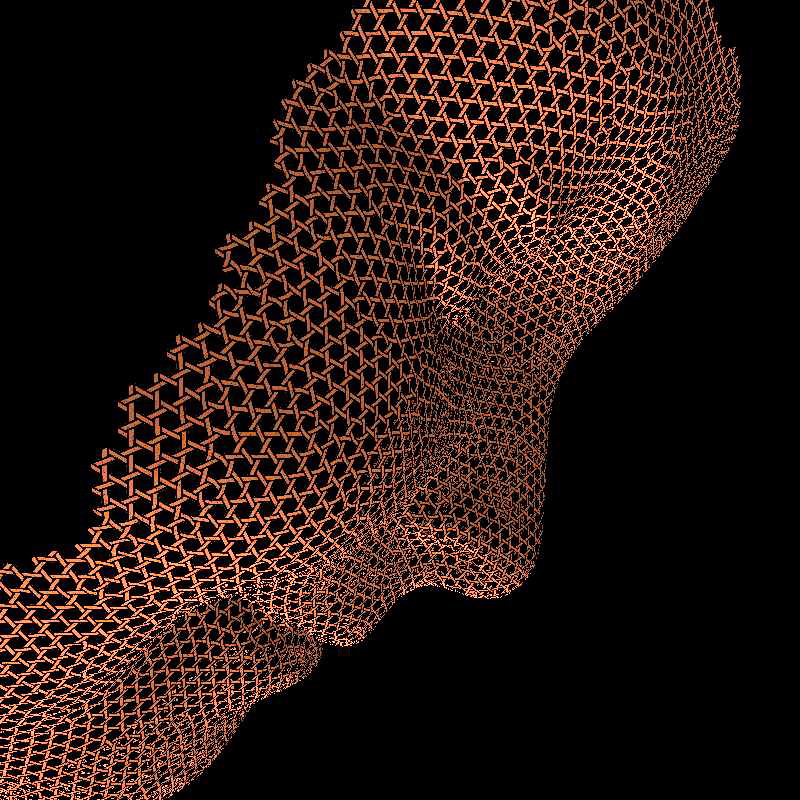
Wednesday, August 2, 2023

Hill-and-valley weaving of voxel object surfaces

Hill-and-valley weaving must follow the medial of a bipartite map. The skeletal surface graphs of voxelized objects (example above) are bipartite. Pasting the truchet tile (below) onto each square face (with corner colors matching) gives a face 3-coloring of the medial graph (the new edges trace the boundaries between colors).

For example, for a single voxel, i.e., a cube, decorating its six faces with the truchet tile, shows that its 3-colored medial is a cuboctahedron (below) with its square faces colored 'saddle' and its triangular faces colored alternately 'hill' and 'valley'.

A spherical cuboctahedron (see below; art by Watchduck) is four great circles in an arrangement of maximum symmetry, so the smallest angles between these planes is equal to the dihedral angles of the tetrahedron, or approximately 70.5288 degrees.

To weave the cuboctahedron weave 'flat' (i.e., without hills and valleys) weavers must cross each other such that the internal angles of the triangular faces are about 70.5288 degrees, a bit wider than the 60 degrees these angles would measure on the plane. To make the triangular faces into hills and valleys, and, correspondingly, the square faces into saddles, we need even wider internal angles in the triangular faces. Below is a hill-and-valley weaving of the cuboctahedron with 100 degree internal angles in the triangular faces. Because of the hills on alternate triangles of the cuboctahedron, the basket appears strongly tetrahedral.

Friday, July 28, 2023

More on the math of hill-and-valley weaving

Above, the quadrilateral domain of a map edge.

Above, the hill-and-valley coloring of the quadrilateral domain of a map edge via Mrs. Stott's expansion, Me(Me(m)). Black = Up; White = Down; Pink = Saddle.

Above, the hill-and-valley coloring of the quadrilateral domain of a map edge via Ring, Me(Su(m)). Black = Up; White = Down; Pink = Saddle.

From the previous post it is clear that we must start from a bipartite map (a bipartite graph embedded in a surface) in order to design a basket that can wear a hill-and-valley corrugation of its surface. There are many such maps. For example, any quadrangulation of the sphere is a bipartite map. Also, since the 3D cartesian grid of points with integer coordinates can be bicolored (e.g., simply color each vertex according to the parity of x+y+z), the surfaces of polycubes and voxelized objects (image below) are bipartite maps regardless of their (necessarily orientable) topology.

If we must start from a non-bipartite map, the map operation Radial (a.k.a., Quadrangulation), which doubles the number of edges in the map, always yields a bipartite map--the partition of vertices being respectively, the original vertices and the new vertices that are added in the center of each original face. Taking the Medial of this map (at the cost of another doubling of edges) yields a weavable pattern. So the entire chained operation on a non-bipartite map m is Me(Ra(m)). Since Medial gives the same result whether applied to a map or its dual; and Ra() and Me() of any given map are in fact duals, Me(Ra(m)) = Me(Me(m)) = Me^2(m). This compound operation, "the medial of the medial", or "medial squared", is also known as Mrs. Stott's expansion.

Another way to make a given map bipartite is to subdivide the edges, in other words, insert degree-2 vertices in the middle of each original edge. So the compound map operation needed in this case is Me(Su(M)), a map operation which I have elsewhere called Ring ("Extra ways to see: An artist's guide to map operations." Hyperseeing: Proceedings of ISAMA 2011, pages 111–121, Summer 2011. See chart below.) because it generates weave patterns associated with chainmail.

Thursday, July 27, 2023

The math of hill-and-valley weaving

A weaving pattern for any graph drawn on a surface can be derived by taking the medial of the graph, a construction that fills the rhombic domain of each edge in the graph with black and white regions as below, (original edge in red, original vertices in green):

That construction suffices for ordinary weaving, but not for hill-and-valley texturing because the black regions, which correspond to the locations of the original vertices, must be partitioned into alternating hills and valleys. So we need to start with a bipartite graph (for example, see below: each edge connects a green vertex to a blue vertex), then the medial will inherit the needed bipartition of the black regions into hills and valleys from the bipartition of the original vertices.

Hill-and-valley weaving with locked crossings

Corrugated surfaces can be woven using locked crossings if the crossings are locked at some angle other than 90 degrees. The sample above was woven using crossings locked at 100 degrees (80 degrees on the acute side), with the distance between crossings fixed at 3x the width. The resulting hill-and-valley corrugation adds a lot of stiffness to the woven panel. The 1-inch wide cardstock weavers were made by hand using a paper cutter and 0.25-inch diameter hand punch. Below is the pattern used to cut the weavers.

Wednesday, June 21, 2023

"Bespoke tet" and "Bespoke cube"

As a demonstration of coding unit weaving in a Cricut layout, the tetrahedron model above, which has a variety of edge lengths and is that sense 'bespoke', is woven together as indicated by its layout.

"Bespoke cube," below, is slightly more complicated model, but still scaled to fit vertically on a 12" long Cricut mat.

Tuesday, June 20, 2023

Coding unit weaving in paper cutting

A digital cutting machine such as Cricut is a practical way to make unit-weavers (such as twogs) in all different lengths, allowing more customized shapes to be woven. There is then the problem of how to keep the different lengths sorted and properly sequenced in the weaving process. I find that narrow paper bridges (the J-shapes) in the model above, can keep twogs sequenced in a way that also codes the weaving moves. For example, reading the model above from top to bottom, the pattern is natural seen as open-left, open-right, close-left, close-right, (knowing that the last move closes up the weaving, 'close-right' is deduced as the only possibility) a weaving pattern that builds a tetrahedron. In fact, the short paper bridges would hardly allow any other pattern to be woven.

Thursday, June 15, 2023

Adams "World in a Square II" on the tetrakis hexahedron

The Adams "World in a Square II" map projection tiles with itself to form a seamlessly periodic Earth. We use identically printed and cut pieces that are triangular after folding, but place rubber bands on only half of the triangles. Each triangle has a complete copy of the Earth's surface, the Western Hemisphere is seen on the face with interwoven flaps, the Eastern Hemisphere is seen on the smooth face.

(The Prime Meridian of the Adams tile has been shrunk to 89% of its true length, resulting in folded triangles that are isoceles and slightly acute to approximate the faces of a tetrakis hexahedron. This is, of course, a fudge to avoid calculating a proper conformal projection, what might be called "World in a (slightly rhombic) Square.")

Since there is never a need to reopen (unweave) the variety of triangles that wear the rubber bands, these can show their smooth side to the weaver, and thus show their Eastern Hemisphere to the weaver.

A quadrangulation can be reduced to an incrementally smaller quadrangulation by a face contraction: shrinking either diagonal dimension of one face to zero. The inverse operation, face expansion, incrementally grows the quadrangulation by opening a path of length 2 into a quadrilateral. Since there is only one sort of face on the cube, and the two diagonals of each face are essentially the same, there is only one way to decrement a cube by face contraction, so there is a particular shape that we can call Cube-1. Likewise, there is only one sort of path of length 2 on the edges of a cube, so there is only one way to increment a cube by face expansion, so there is a particular shape that we can call Cube+1. (The fact that the "squares" in this model are actually composed of four hinged triangles, lets us play this freely with solid geometry.)

In the strip of photos above, we start with Cube+1, then contract 2 faces to reach Cube-1. So what happened to Cube? To reach Cube from Cube-1, we must go back to Cube+1 and contract a single face. This indirection is necessitated by the limits of simulating topological transformations via physical folding. If our ambition was only to reach Cube from Cube-1, then we stuck with one quad's worth of unnecessary surface riding piggy-back on Cube.

Reducing Cube-1 down to a one-faced quadrangulation (photo strip above) proceeds directly because in each step we we are simply folding down a "flap" formed by a vertex of degree-2.