Thursday, March 21, 2013

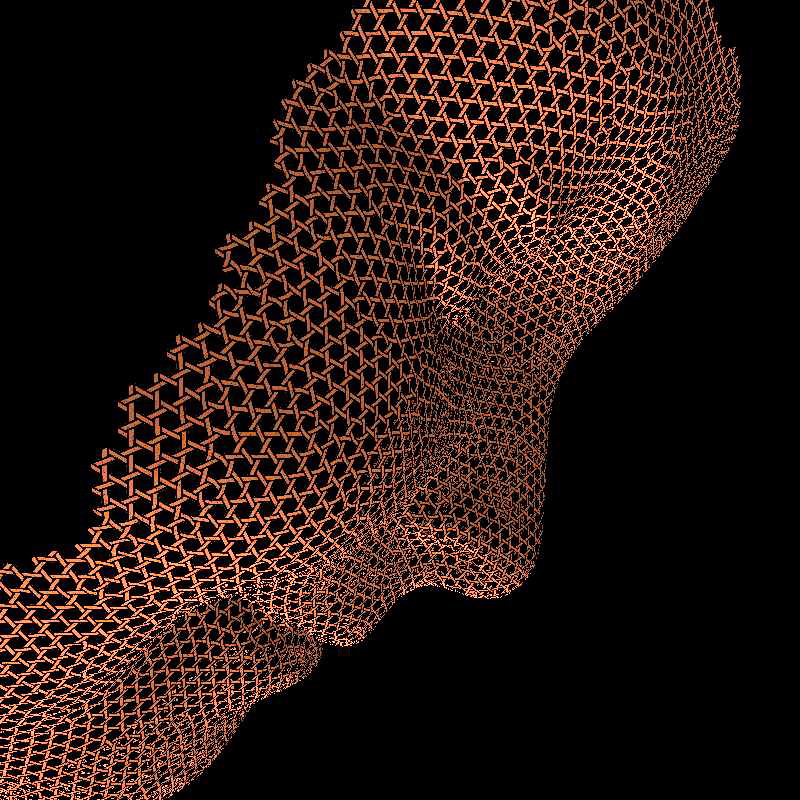
A second try at First Ground


This is a denser First Ground than yesterday's. It has the same number of stitches between crochets as in de Dillmont's. (4 stitches = 4 steps = 2 strides.)  No longer is there an attempt to have two loops engaged at the dismounts. The undip formula is unchanged:

u (nu)a [uu (up)a nn (nd)a]x.

At two steps (one stride) per triangle, this is the smallest truchet that can be used with an arbitrary undip code. (One step per triangle loses its walking rhythm when the code does not alternate left and right.)

Wednesday, March 20, 2013

"First ground" in walking stitch crochet


This is a walking stitch pattern for a crocheted fabric similar to Thérèse de Dillmont's first ground for Irish crochet lace. The undip code is:

u (nu)a [uu (up)a nn (nd)a]x.

The scale is twice that of de Dillmont's because the interval between crochets here is four strides rather than four steps.


Image of "first ground" for irish crochet lace from "Irish Crochet Lace" by Therese de Dillmont.


de Dillmont's instructions for First Ground.

Tuesday, March 19, 2013

Walking crochet patterns

Here are walking crochet patterns on all the shapes that can be made with undip words of 2, 4, or 6 letters.


 The particular codes used:

ud                     undp                      uunddp

                         uudd                      uundpd
                   
                                                       uududd

                                                       uuuddd

Truchet tiles for walking crochet


Assembled according to an undip code word, these triangular truchet tiles show the tracks of the two-legged horse and the clowns.

Thursday, February 28, 2013

Wire bending jig for zip crochet


This is typical of the jigs I have used. The dowel pins have a diameter about 7x that of the wire. The spacing between the two lower pins is about 1.7x the wire diameter. The altitude of the triangle connecting the centers of the pins is about 14 wire diameters.


Bending 8 gauge AWG copper wire.


A walking chain stitch being assembled.

Zip crochet: splices


A zip crochet splice.

The chain (the horse's path) must splice to itself at the completion of the work. This is easily accomplished by overlapping a few links. If the wire is cut just past a bend, that bend can be bent further to seize some portion of the other end of the chain.


A half-completed splice.

Tuesday, February 26, 2013

Bent-wire crochet: remounts


Where a clown remounts the horse, or, in plain speech, at the base of a crochet stitch, the left/right rhythm of the chain needs to be maintained. The approach diagrammed above seems to be the most practical. The reach, the first part of the crochet stitch (the angled red line in the diagram,) determines the path of the returning chain stitches. The reach needs to be angled backwards so that at least one of the fully completed links of the chain can be engaged. In the finished fabric this three-way join will be deformed into a nearly equiangular 'Y.'


Beginning of a remount in bent-wire crochet.