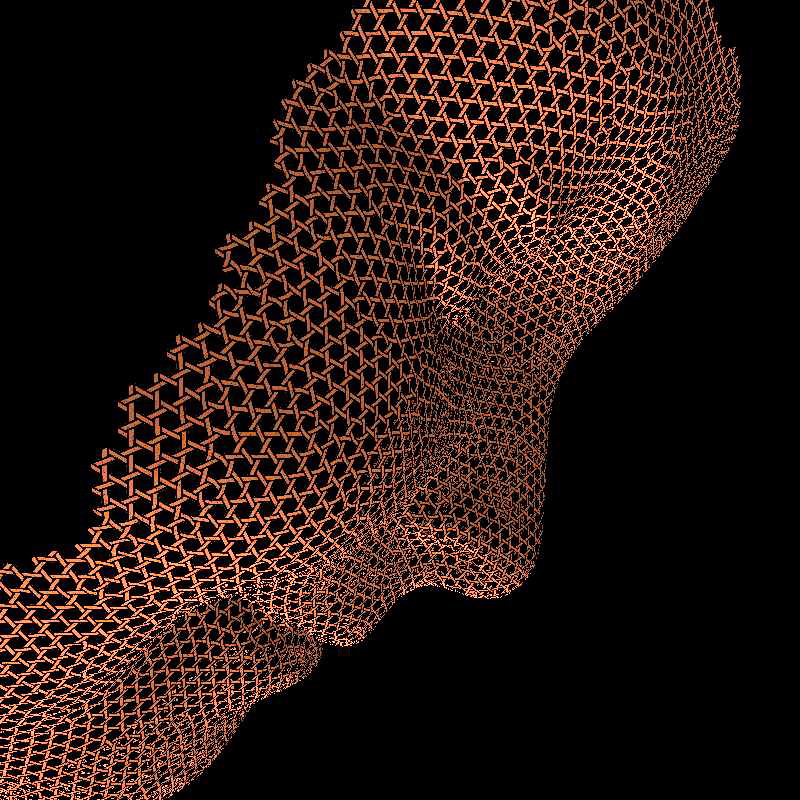
Friday, June 21, 2013

Opening and closing at an all-outboard vertex

At an all-outboard (mmm) vertex, the six unit weavers appear as two sets of three "flaps."

The three flaps on the outer face open like a cardboard box tops, as though a box had three tops, all arraged with rotational symmetry around a corner.

Opening an outer flap at an all-outboard corner.

Opening the third outer flap.


Opening the three outer flaps leaves a flower-like arrangement with three inner flaps still closed in the center in a reciprocal, nexorade-like pattern. Simply lift these up.

Opening the three outer flaps reveals a flower-like pattern with the three inner flaps still closed in the center.


Making puck weavers from aluminum flashing

A puck weaver made from aluminum flashing.

Cut strips that are about 0.05" narrower than the intended distance, s, between the "square" folds (in the pictured weavers s = 2.5". The strips should be at least 4s long.

Make the square folds, trimming off any excess beyond the fourth square. When folding begin in the middle and work outward—never reaching the edge. Never press closer than about 1/4" from the edge to prevent bending the edge in too sharp a radius.


After cutting and making the square folds.

Make one set of diagonal folds, ideally, due to the narrowed width, these should follow a 45-degree line and fall just short of intersecting the square folds. (Intersecting folds over stress the metal.) If the piece is flipped over so that the square folds show as mountain folds, the diagonal folds show as valley folds. Note that you must skip a square when making these two diagonal folds.

After the first set of diagonal folds.

Now make the remaining two diagonal folds which are aligned 90 degrees to the first.


After folding.

With scissors or tin snips round off the four corners.

After rounding the corners.

Theoretically you should adjust the square folds to a 90 degree dihedral angle and the diagonal folds to a 70.5 degree dihedral angle, but you may want to compromise with your intended surface. The final state of the square folds will always be 90 degrees of dihedral angle, but such tight bends may be difficult to work with in a very small basket. The final angle of the diagonal folds will vary with surface and whether you are working points in or points out.


Thursday, June 20, 2013

Frequency-1 puck weaving of the tetrahedron

A tetrahedron in frequency-1 puck weaving. The forward corner is an all-outboard vertex. (The tetrahedron is self-dual. Putting cube-corner pyramids on the triangular faces of the dual tetrahedron makes a cube.)

In frequency-1 weaving of the tetrahedron, the diagonal corrugation folds open out to 180 degrees, effectively disappearing. We are left with a set of three composite weavers essentially having only the square folds. These form a cube-like surface (actually a tetrahedron decorated with cube corner pyramids) from three orthogonal, belt-like paths. Two unit weavers overlap to form each belt. The total number of unit weavers used is 4*1.5 = 6.

Within each composite belt, body diagonals of the "cube" connect points of the same type. Therefore, if we start at an all-outboard point we can finish at the body-diagonally opposite corner of the "cube" at another all-outboard point.

All-central = www. All-outboard = mmm.

A 4-square puck weaver in standard position with points labelled.
A more self-explanatory terminology for vertices that are mmm or www, is all-outboard and all-central.

We wish to end our weaving at an all-outboard vertex (formerly mmm) so we can tuck it closed like the flaps of a box.


A completed all-outboard (formerly mmm) vertex in puck weaving.

A completed all-central (formerly www) vertex in puck weaving.

When finished, an all-outboard vertex naturally looks tidy because no unit weavers come to an end at its folds. An all-central vertex will look messy if the ends of unit weavers are visible, as in the photo above.

1.5 unit weavers per vertex

Only unit weavers measuring an even number, N, squares in length are permissible if we wish to hide the splices on both of the faces. If the phase shift used in building up the composite weaver is 2 squares, the thickness of each composite weaver is N/2 plies. But, since the weavers cross two-by-two in what is locally a tabby weave, the basket itself will be N plies thick.

Each vertex in the trivalent primal map "owns" one triangle in the triangle-faced dual map. In turn, this triangle "owns" three half-squares of tabby weave. Since these three half-squares are N plies thick, each triangle (and in turn each primal vertex) "owns" 3*N/2 squares of unit weaver. Since the unit weavers themselves are N squares long, the consumption of unit weavers is 1.5 per primal vertex, regardless of length, provided the phase shift is 2.

Ending up at an mmm vertex

The points-out side of a frequency-1 korgome weaving. The "points" correspond to the vertices of the primal, trivalent map.

We'll take the trivalent map as the primal description of a korgome basket because, for example, we probably have better intuition about the cube (which is trivalent) than about its dual the octahedron, and about the dodecahedron (which is trivalent) than about its dual the icosahedron.

Taking that viewpoint, the "points" in korgome weaving correspond to vertices of the primal trivalent map, and the triangles (so evident from the points-in side of frequency-1 korgome shown below) are faces of the dual triangle-faced map.

The points-in side of a frequency-1 korgome weaving. The evident triangles correspond to faces of the triangle-faced, dual map.

The path of a korgome weaver corresponds to a zig-zag (a.k.a. a left-right path or Petrie polygon) in the primal, a triangle strip in the dual, and a central circuit in the medial of either primal or dual since Me(M) = Me(M*).

The complete network of folds in frequency-0 korgome is the radial of either the primal or the dual since Ra(M) = Ra(M*). However, frequency-0 korgome is only possible if the primal map is bipartite.

(An abstract graph is bipartite if and only if its vertices can be colored "black" or "white" such that no two vertices with the same color are adjacent. If such a vertex 2-coloring of the graph exists, it is unique up to color rotation and is easily discovered by simply starting coloring.)

The complete network of folds in frequency-1 korgome is ko of the trivalent primal, Ko(M), and kis of the triangle-faced dual, Ki(M*). Frequency-1 korgome is possible for any trivalent primal map. 

Every polyphase weaver which is composed of unit weavers of even length has a w-side and an m-side (assuming, as always, we are observing the points-out face of the fabric.) Backtracking from the vertex we wish to finish weaving at, we can make that vertex mmm simply by correctly orienting its three polyphase weavers. In general, this leads to complicated constraints on the construction sequence since we must correctly orient three polyphase weavers wherever each is first encountered in the weaving.

The situation is much simpler if the trivalent primal is bipartite. Then we can start with a www vertex and sequentially add unit weavers subject to the rule that every vertex must be either www or mmm. If the primal is indeed bipartite, all will go well. At the end we will either find ourselves at an mmm vertex or right next door to one.

The cube is a simple example of a bipartite map. If we dangle a cube from one corner, we can color the bottom corner white and follow the bipartite coloring rules to color the other corners until we finish with a black corner at the top. Accordingly, in korgome weaving the basket described by this trivalent map, we should start at the bottom with a www point and make only www or mmm points until we end up at an mmm point at the top.


The cube has a bipartite map.


Being bipartite, this map admits a frequency-0 korgome weaving. In order to finish at a point-out, mmm vertex at the top corner of the cube, we can start at a point-in, www vertex at the bottom corner.


Puck weaving started with the aid of spring clamps. A completed www vertex is below, a completed mmm vertex is above. The plane can be woven with vertices of just these two types.

Another bipartite trivalent map is the (infinite) map of hexagons tessellating the plane.


The tessellation of the plane by hexagons is a bipartite, trivalent (infinite) map.

Tuesday, June 18, 2013

Weaving and Petrie duality

The hemicube, Petrie dual of the tetrahedron. Sculpture by Carlo Sequin. Image quoted from  www.cs.berkeley.edu.

The universality of weaving can be expressed by stating that a basket is an embodiment of the Petrie dual of a map. The familiar sort of map duality (Poincaré duality) interchanges faces and vertices. It is a rather friendly duality because it does not take us to a different surface. But every map also has a Petrie dual. The Petrie dual interchanges faces and zig-zag paths, and, generally speaking, the Petrie dual describes a different surface. For example, the tetrahedron, which is a map of the sphere, has as its Petrie dual the hemicube, which is a map of the projective plane.

The sculpture of the hemicube by Carlo Sequin shown above exemplifies a way to visualize the Petrie dual of a spherical map. A spherical map can be realized as a wire frame with soap films stretched across its faces. To model the Petrie dual, stretch the soap films, not across faces, but a across the zig-zag circuits, that is, the sets of edges formed by alternately taking left and right turns at each vertex.

Of course, weaving elements do not follow zig-zag circuits, rather they follow central (straight ahead) circuits in the medial of the map. Deza and Dutor in "Zig-zags and central circuits for 3- or 4-valent plane graphs," show that the zigzags of a plane graph G are in one to one correspondence with central circuits of Med(G). A visual argument extends this result to non-planar trivalent maps by considering a truchet tiling of the map's triangle-faced dual, as shown below.


Both the zig-zag and the central circuit correspond to a loop of triangles in the dual—which may or may not be a Mobius strip. 

Nederland-Skoviera-Zlatos, 2001: The Petrie dual of an orientable map M is orientable if and only if M is bipartite.