Wednesday, September 29, 2010

Twongs Thronged at NY Maker Faire!

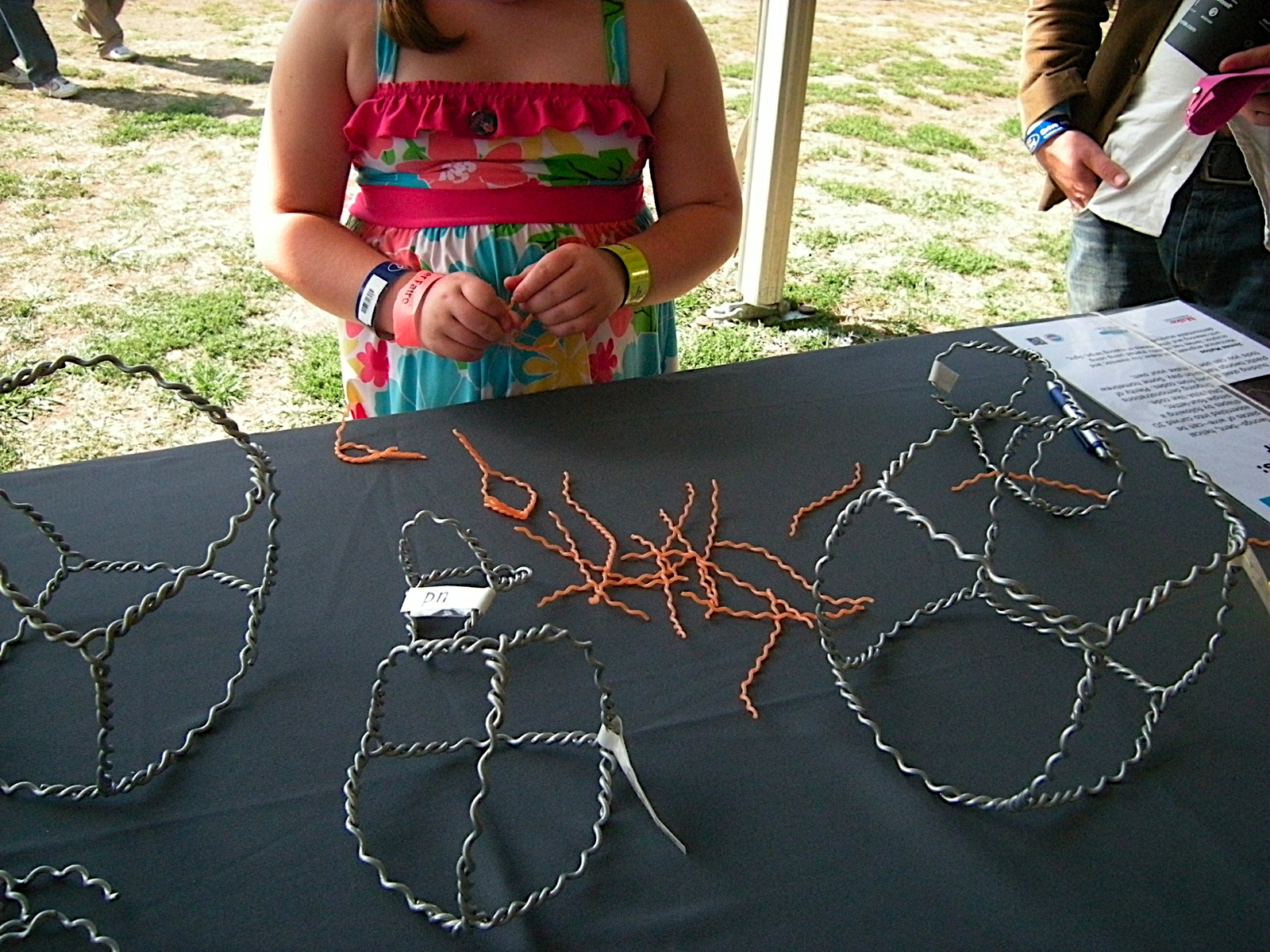
Visitors thronging the Twongs Table at the New York Maker Faire, September 25-26, 2010.
That's me in orange. Some tried making the carbon chemistry models (annulenes) displayed in steel, but most went freeform.
All ages advanced to level 101: having fun.
The steel models wore their undip codes attached.
Tetrahedrane in foreground, acetylene in back.

Friday, September 17, 2010

Catalan Numbers and Baskets

How many undip words are there?


The famous Catalan numbers turn up in many places ( see "Exercises on Catalan and Related Numbers" and "Catalan Addendum" by Richard P. Stanley.) One of the classic examples is counting the number of ways 2n people seated around a table can simultaneously form n handshakes without crossings. The answer to this problem is the nth Catalan number. For example, the Catalan numbers for n = {0, 1, 2, 3, 4, 5} are {1, 1, 2, 5, 14, 42}.


Another set counted by the Catalan numbers are the number of words in the Dyck language that contain n pairs of parentheses. The Dyck language comprises all strings of open and close parentheses that follow the usual rules of arithmetic expressions. For example:


()

(()) ()()

((())) ()(())) (())() (()()) ()()()

etc.


The undip language is a shuffle of two Dyck languages: a {u,d} language and an {n,p} language. We can think of {u,d} as {(,)} and {n,p} as {[,]}, but unlike a Dyck language on two types of parentheses, in a shuffle of two Dyck languages the two types of parentheses ignore each other grammatically speaking. For example, a word such as:


( [ ) ]


is permitted.


R. Cori, S. Dulucq, and G. Viennot explain how the Catalan numbers are related to the planar hamiltonian cubic maps (the structures described by undip codes) in "Shuffle of Parenthesis Systems and Baxter Permutations," Journal of Combinatorial Theory, Series A 43, 1-22 (1986):


"...hamiltonian cubic maps are planar maps with a hamiltonian circuit in which all vertices have degree three. In such a map any vertex is incident with only one edge not in the hamiltonian polygon, this edge may be inside the polygon or outside. Thus to build a 'Hamiltonian rooted cubic map' one has to choose 2k vertices among the 2n (those incident with inside edges) then draw a planar map inside the polygon (it is easy to see that this can be done in Ck ways*) and a planar map outside."


*This is easy to see because it is essentially the handshaking problem.


A map is rooted by distinguishing a vertex and direction. In a hamiltonian circuit this is combinatorially equivalent to labeling all the vertices, since, given a direction and a place to start, we can reliably label the vertices with sequential integers. Working with a rooted map, every rotation of a pattern counts as a distinct pattern because the root occupies a different place in each rotation. Counting rooted maps exhaustively counts all of the possible undip codes even when they trivially encode the same shape by virtue of merely starting at a different location on the hamiltonian cycle.


Cori, Dulucq, and Viennot go on to show that the number of rooted hamiltonian planar cubic maps are counted by the product of two sequential Catalan numbers. For a hamiltonian circuit with 2n vertices the number of maps is the product of the nth Catalan number and the (n+1)th Catalan number.


Tthe number of undip words of length 2n for n= {1, 2, 3, 4, 5} are {2, 10, 70, 588, 5544}. This is sequence A005568 in the On-Line Encyclopedia of Integer Sequences (OEIS).


For better or worse, there are a great many more undip words than there are shapes to be described by them. Synonyms will abound.


Friday, September 10, 2010

O-Knitting

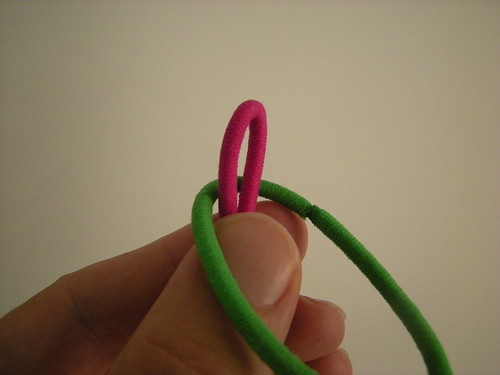
Making an o-knitting vertex, Step 1: Hold Needle upright.
Toss Quoit on Needle.
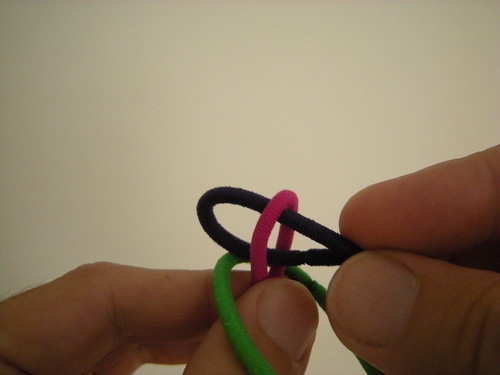
Feed Thread through Needle.
Pull Quoit through Thread.
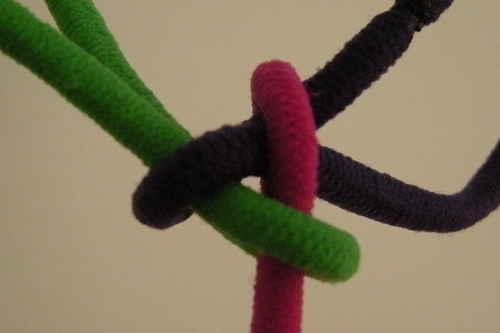
Voila! a completed vertex.
Close-up of completed o-knitting vertex.
All sorts of things that I'll call o's are available to the craftsperson: rubber bands, ponytail holders, potholder loops, etc. O's can also be made at home by slicing across a can or plastic bottle, or anything else of tubular cross-section. O's can be knit together to form 3D shapes without the increases and decreases traditionally depended upon in knitting and crochet. O-knitting can optionally be guided by a string of letters drawn from a four-letter alphabet, what I call an undip word, that describes the step-by-step construction of a surface. Using undip words, o-knitting becomes a sort of genetic knitting.

There are only two big things to learn about o-knitting: how to make a vertex, and how to follow an undip code. Learn those two things and you will be a able to build a spaceship on a desert island, or at least a floppy grass model of one.

An o-knitting vertex is an inter-looped union of three o's. An o-knitting vertex is a reciprocal structure. That is, each of the o's plays the same role in the union. We'll give each o a name according to how it first enters the union, but by the time we are done making the vertex they'll all be equivalent. An o-knitting vertex is a three-way version of Mrs. Bright's (four-way) True Lovers' Knot (Ashley Book of Knots #2425.)

OK, let's make an o-knitting vertex. The first o is called Needle. Except at the very first vertex (call it the origin,) Needle will already be attached to the work. Hold Needle with its free end upward.

The second o is called Quoit. Quoit is always free at both ends. Toss Quoit over Needle.

The third o is called Thread. Feed Thread through Needle. It is best to always feed Thread from the right side (or always from the left side, if you prefer.) Feeding from the same side makes vertices that are all of the same handedness, giving the fabric a more even look. Thread will be free at both ends when making u and n vertices, but already in the work when making p and d vertices.

Now feed Quoit through Thread (i.e., through the end of Thread that pushed out through Needle.)

Voila! One vertex made. 3D shapes are made by repeating the above moves.

3-D shapes may be specified by an undip word or genotype, a character string made up of the four emoticons: u, n, d, and p.

For example, a genotype for the cube is

nuupdd .

The the letters are called emoticons because they are meant to be read with the head tilting sideways (toward the right) and their meanings are visually obvious—no need to wake up the left side of the brain at all. The four o-knitting actions they encode are:

"Open left," meaning: "make a new vertex and leave the o on the left side dangling," (i.e., continue to the right. )
"Open right," meaning: "make a new vertex and leave the o on the right side dangling," (i.e., continue to the left.)
"Close left," meaning: "make a new vertex employing the nearest dangling o on the left side."
"Close right," meaning: "make a new vertex employing the nearest dangling o on the right side."

(Figure out for yourself which emoticon encodes which action.)

Note that at a close vertex the roles of Needle and Thread can be assigned so that Thread enters Needle consistently from the right (or, alternatively, consistently from the left.) A switch causes no confusion about how to continue, since just a single o is left dangling after a close vertex.

You have to work consistently from the outside of the piece (or consistently from the inside.) Early on this will mean taking care that o's do not get twisted. At the end, should you find you have made the enantiomorph of what you intended—no problem. Just evert the piece through one of its openings.

Quoit must always be free at both ends, but at the final vertex all three o's will already be attached to the work. The final vertex must be joined by some other technique. The simplest way is to add a fourth o as Quoit, making the last vertex a regular fourway Mrs. Bright's knot. The extra o is left dangling, permanently marking the origin (and terminus) of the undip word.

Hansel & Gretel's Hint: mark your very first o with a twist tie or special color—should you get lost, you can can retrace the word from the beginning.

Tuesday, August 31, 2010

Embedded graphs come in families of four

Cubic graph (the dual)
Triangulation (the primal)
Radial graph
Medial graph
Kagome weave
Anyam Gila
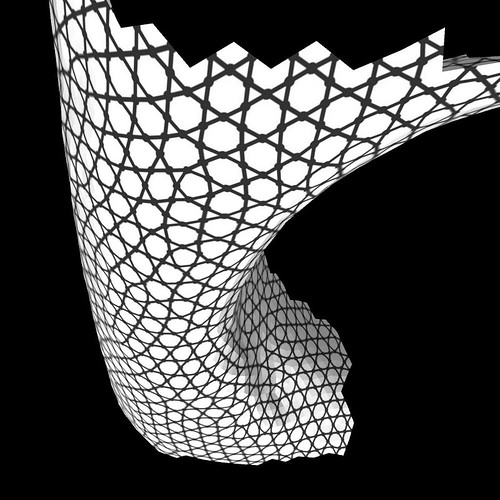
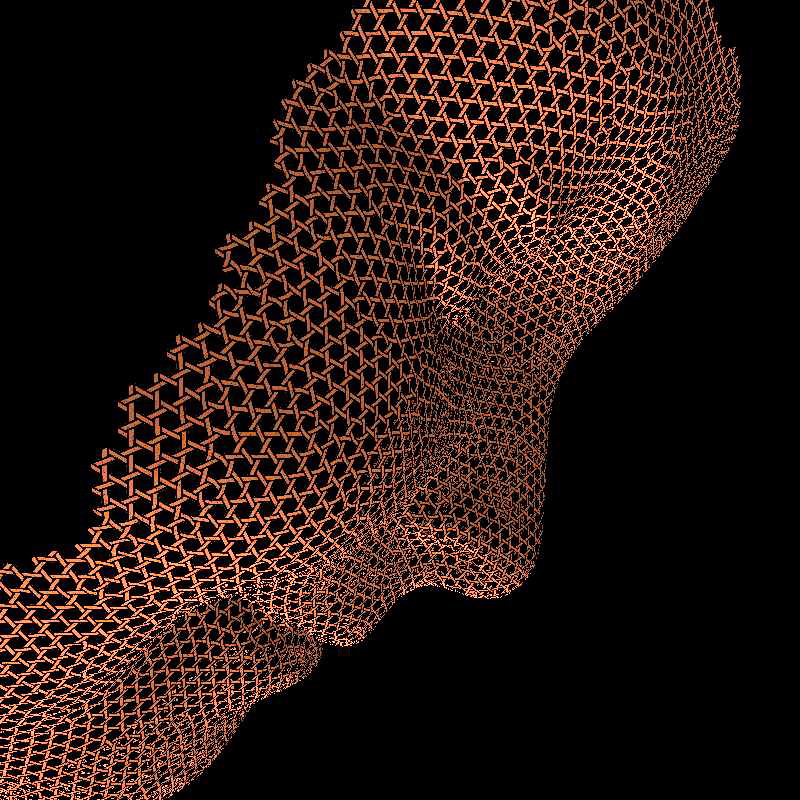
In unit weaving we are constantly dealing with families of four closely related graphs: a triangulation (the primal graph), a cubic graph (the dual graph), a medial graph, and a radial graph. Kagome (triaxial weaving) is closely related to the medial graph of a triangulation. Anyam Gila (or "mad weave"), a triple-layered version of kagome, has an outward appearance that suggests the radial graph of a triangulation.

Some facts from the Handbook of Graph Theory:

1. An embedded graph M is a medial graph of some graph G if and only if M is 4-regular and the faces can be properly 2-colored.

2. An embedded graph R is a radial graph of some graph G if and only if R is bipartite and every face is a quadrilateral.

3. The medial graph M of an embedded graph G is identical to the medial graph of the dual G*. The radial graph R of G is identical to the radial graph of the dual G*. The embedded graph and its dual are the only two graphs whose medial and radial graphs are M and R respectively.

Any surface-embedded graph can play the role of "primal," and it is guaranteed to have a dual, medial, and radial, all of which are discoverable through simple constructions called map operations. It is a convenience of speech that we identify one graph as the primal and the other as the dual: the roles could just as easily be reversed with no effect on the rest of the foursome. The same, however, is not true for the medial and radial (which are also mutually dual,) because radial graphs and medial graphs each have special characteristics as indicated in Facts 1 and 2 above. Thus, most graphs belong to only one foursome: the one formed when they are the primal (or equivalently the dual.) The few graphs that qualify as medial (or radial) graphs belong as well to a second foursome: the one where they are the medial (or radial.)

The familiar square grid makes for a special case. It is dizzyingly at once self-dual, self-medial, and self-radial. This deep symmetry of the grid pattern helps explain why 10,000 years of biaxial weaving has not gotten us very far in understanding weaving more generally.

When plain weaving is not in some artificially arranged conformation, just two threads cross at each crossing. A graph of a plain weaving (crossings being represented by vertices and threads being represented by edges) is therefore four-regular (i.e., exactly four edges meet at each vertex.) That satisfies the first requirement in Fact 1.

The relevance of the second requirement in Fact 1 can be seen from an observation by Snelson (U.S. Patent 6,739,937), that each thread in a plain weaving is a boundary between a left-handed opening and a right-handed opening. Such an arrangement is only possible if the fabric openings can be properly 2-colored (such a coloring is popularly known as a chess-coloring or checkerboard-coloring.)

The necessary and sufficient requirements for a graph to be a medial graph are thus the same requirements necessary and sufficient for a graph to specify a plain weave: the 4-regular graph specifies the two-dimensional arrangement of threads, and the 2-coloring of its faces tells us which openings are to be left-handed or right-handed. The handedness of the openings, in turn, tells us how to arrange the threads at each crossing, in the third dimension, to produce a true plain weave.

In this light, Fact 1 establishes that every medial graph describes two enantiomorphic plain weaves (one for each of the two alternate left/right color assignments.)

In the same light, the converse assertion in Fact 1 (i.e.: if M is 4-regular and the faces can be properly 2-colored, then M is a medial graph) establishes that no plane weave exists that is not described by a medial graph.

In short, weaving has found the light switch after thousands of years of fumbling in the dark:

1. We now know that every compact surface can be plain-woven-- no matter the topological complexity or the orientability of the surface. (The term "compact" merely rules out some mathematically defined surfaces that cannot be realized by any technological means. In layman's terms we can plain-weave any surface.)

2. We can plain-weave that surface in essentially any pattern (we are not limited to familiar biaxial or triaxial weaves.) Any graph, any drawing of edges and vertices we choose to put on the surface, can direct the weaving via its medial graph.

3. We know constructively how to proceed in every case.

4. We know that our construction process is universal: there exist no other plain weaves but those described by medial graphs.

We have 1-3 above from the 2009 topological proof by Akleman, Chen, Xing, and Gross (see my earlier post Proving Weaving) I believe the universality result is new.

Sunday, August 29, 2010

Undip codewords as lattice walks

Any undip word can be identified with a 2D lattice walk where the allowed steps are N, S, E, W, the walk begins and ends at the origin (such a lattice walk is called a loop), and the walk is furthermore confined to the first quadrant (quarter plane).

Identify 'u' with an North step, and 'd' with an South step (mnemonically 'up' and 'down'). Similarly identify 'n' with an East step and 'p' with a West step.

The "balanced parentheses" rules for undip words (where |x| denotes the number of occurences of the letter 'x') are:

|u| = |d|

|n| = |p| ,

These rules guarantee that total South steps equal total North steps, and total West steps equal total East steps; thus, if a codeword-designated walk begins at the origin, it will end at the origin.

The "nested parentheses" rules guarantee that the walk stays in the first quadrant. The rules are:

|u| >= |d|

|n| >= |p|

for any predicate of an undip word.

In other words, at no point in the spelling of an undip word will there have been more d's than u's, or more p's than n's. On the lattice this means that the walk can never go south or west of the origin-- it is confined to the NorthEast quadrant.


Undip codes and Euler's Formula

Any graph embedded in the sphere must obey Euler's formula:

F - E + V = 2 ,

where F, E, and V are the number of faces, edges, and vertices. Since every hamiltonian cubic graph embedded in the sphere has a valid undip codeword, a reasonable question is how (and whether) having a valid undip codeword can guarantee compliance with Euler's Formula.

Euler's formula is a bit simpler for cubic graphs. Cutting a cubic graph at every mid-edge, leaves a disconnected set of vertices, each still holding on to three half-edges. Thus,

E/V = 3/2 .

That fixed E/V ratio reduces Euler's formula for a cubic graph to

F - V/2 = 2 ,

or

F = V/2 + 2 .

In a valid the undip codeword there is one letter for each vertex. For every open letter, 'u' and 'n,' there is a matching close letter, 'd' and 'p'. Therefore a count of the occurrences of d and p, |d, p|, will count one half of the vertices:

|d,p| = V/2 .

Euler's formula then becomes

F = |d,p| + 2 .

It is easy to see that in weaving a valid undip codeword this rule is always obeyed. Each close letter, 'd' or 'p', completes a face, until we come to the final close letter. The final close letter also completes the hamilton cycle and thereby closes an additional face on both the left and the right-- that provides the final "+ 2" faces.

Friday, August 27, 2010

What can undip codewords code?


Twongs and twogs can make more shapes than the four-letter undip code can code.

A graph must have a Hamilton circuit in order to be undip encoded. (Note that Hamiltonicity is a property of the graph, not the embedding.) That leaves out cubic graphs with self-loops (cubic pseudographs proper) since they can never be Hamiltonian. Only cubic multigraphs can be undip coded.

Furthermore, the embedding must be in the plane (or equivalently the sphere) in order for the coded side bonds to link up predictably. On a higher genus surface, the whole surface area might be encoded in the predictable planar way, but there will remain a closed curve (i.e., the polygon of the plane model, see A Combinatorial Introduction to Topology by Michael Henle) that cannot be seamed across without encountering a surprise.


The photo above shows a digonal prism. Even though a digonal prism is a graph embedded in the sphere, it is not considered a polyhedron by most definitions. For one thing, it contains two-sided faces (digons); for another, it is only 2-edge connected. (Cutting just the two edges shown vertical in the photo would separate the graph into two components.) Note that these are properties of the graph itself, not the embedding. Graphs that are only 1-edge or 2-edge connected make weak structures but they certainly are of sculptural interest. Polyhedron or not, 'udud' codes the digonal prism nicely.


Taking the adjective "plane" to mean "embedded in the plane or sphere," the undip code can encode Hamiltonian plane cubic multigraphs.